
For domain reselling in 2026, Openprovider beats Namecheap on key metrics. Namecheap’s knowledge base confirms that it offers API access, not a dedicated domain reseller program. Openprovider has served resellers since 2004 offering cost-price rates on 2,000 TLDs, compared with Namecheap’s 1,000. Openprovider runs a modern REST API with JSON responses, while Namecheap’s API returns XML. Namecheap suits individual domain buyers. Openprovider fits agencies, hosts, and MSPs managing 50+ domains.
Choosing between Namecheap and Openprovider for a domain reseller business means choosing between two different models. Namecheap is a retail registrar with an API attached. Openprovider is a dedicated wholesale platform built for resellers. That difference shapes pricing, TLD coverage, API design, white-label control, and the margin you keep on every domain.
This guide compares Namecheap and Openprovider across 10 categories. These include wholesale pricing, TLD count, API quality, white-label control, automation, support, and total cost of ownership. We based the comparison on publicly available product info, published documentation, and third-party reviews. Our goal is to help readers assess which platform best fits their needs, not discredit either provider.
Namecheap vs Openprovider quick side-by-side comparison table)
| Feature | Namecheap | Openprovider | Winner |
| Primary model | Retail registrar | Wholesale reseller platform | Openprovider |
| Dedicated reseller program | ❌ “Currently, we do not have a domain reseller program” | ✅ Built for resellers since founding | Openprovider |
| Pricing model | Markup + tiered discounts (SSL only) | Flat-fee Membership unlocking cost-price domains | Openprovider |
| TLD coverage | 1,000 TLDs | 2,000+ TLDs | Openprovider |
| AI agent/MCP access | Unofficial, community-built MCP servers only | Official MCP server (domains, DNS, SSL) | Openprovider |
| API format | XML only | REST and JSON, OpenAPI-spec | Openprovider |
| API rate limits | 20 requests per minute | 60 requests per minute | Openprovider |
| Production API access | Requires $50 balance, 20+ domains, or $50 spent in 2 years | Starts from $4,99 | Openprovider |
| White-label control | Partial, Namecheap contact details appear by default | Partial backend white-label enabling fully branded checkout flows and white-labelled bundled products | Openprovider |
| WHMCS module | Available | Official maintained | Openprovider |
| Plesk and Blesta modules | Limited (mainly as cPanel option) | Official partner | Openprovider |
| Upselling to your customers | ⚠️Yes, hosting, VPN, and email cross-sold | ❌ No upsells | Openprovider |
| Compliance | ICANN-accredited | ICANN-accredited, ISO 27001-certified, NIS2-compliant | Openprovider |
| Best for individuals | ✅ Easy retail UX | Steeper learning curve | Namecheap |
Namecheap and Openprovider: 10 Key differences
Each section below compares both domain reseller platforms and names a winner.
1. Reseller program model

Namecheap: Namecheap has no formal reseller program. Per its own knowledge base: “Currently, we do not have a domain reseller program. Still, you can resell domains with us using our API.” It’s a retail registrar with API access, not a dedicated reseller platform.
Openprovider: Openprovider is a specialized domain reseller platform that has served resellers for over 20 years. Its business model is purpose-built around resellers: agencies, hosting companies, MSPs, and SaaS platforms. It does not run a retail consumer business competing for attention.
Winner: Openprovider decisively.
2. Pricing: Markup vs cost-price
Namecheap: Namecheap runs on a markup model with tiered SSL reseller discounts starting at $50 in spend. Domain pricing stays close to retail, with bulk discounts only.
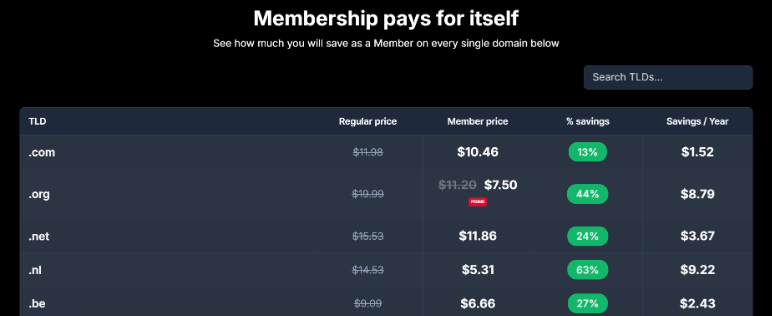
Openprovider: the Openprovider Membership unlocks domains at a cost-price across 2,000+ extensions in one place. Membership plans start from $4.99/year. With Memberships, you pay what Openprovider pays the registry.
A .com costs $10.44 at Openprovider for members against $10.98 at Namecheap. At renewal, Namecheap rises to $18.48/year, while Openprovider’s price stays at $10.44. Across 500+ domains, this renewal gap can add up to thousands of dollars per year.
Whether you’re managing 50 domains or 5,000, the cost-price at Openprovider stays flat. Namecheap’s markup doesn’t.
Winner: Openprovider, by a wide margin for serious resellers.
3. TLD coverage: 1,000+ vs 2,000+
Namecheap: 1,000+ TLDs. Strong on major gTLDs and popular new extensions. Weaker on European ccTLDs and niche options.
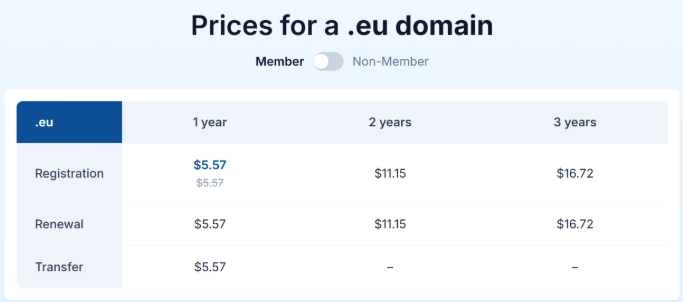
Openprovider: 2,000+ TLDs, the largest catalog among reseller-focused platforms. It has deep coverage of European ccTLDs, plus extensions across Asia and the Americas.
Why it matters: every TLD you cannot sell is a customer you may lose. International buyers who need a country-code domain may look elsewhere.
Winner: Openprovider, with a catalog two times larger.
4. API Quality: XML vs REST + JSON
Namecheap: XML-only responses, with no JSON option. Rate limits sit at 50 requests per minute and 700 per hour. Bulk transfer supports 50 domains. No official SDKs beyond a Terraform provider. Production access needs a $50 balance, 20+ existing domains, or $50 spent over the last two years.
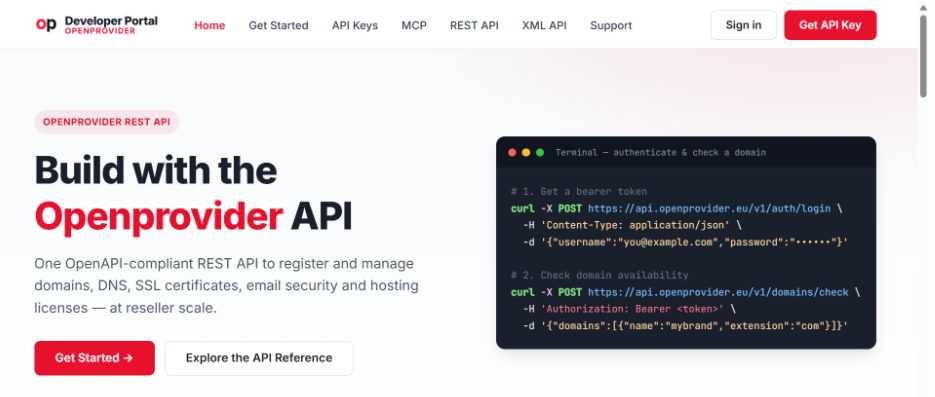
Openprovider: REST and JSON, built on the OpenAPI spec. It handles millions of requests each month and includes a sandbox, IP allowlisting, and 2FA. Public documentation and community SDKs are available for Python, JavaScript, and PHP. EPP is also available. Bulk transfers support 500+ domains.
Openprovider also offers an official MCP server. AI assistants can use it to register domains, edit DNS, and order SSL certificates through natural-language requests.
Why it matters: XML can be harder to integrate, debug, and pair with modern stacks. Strict rate limits can cap how fast you grow. Also, AI-agent access to Namecheap currently runs through unofficial, community-built MCP servers, not the Namecheap platform itself.
Winner: Openprovider, on technical grounds.
5. White-label Control
Namecheap: partial white-label. By default, Namecheap’s contact details such as sslsupport@namecheap.com appear in transactional emails sent to your customers. You can set custom technical contacts for SSL, but full brand replacement is limited. Namecheap branding can also appear in renewal emails and WHOIS records.
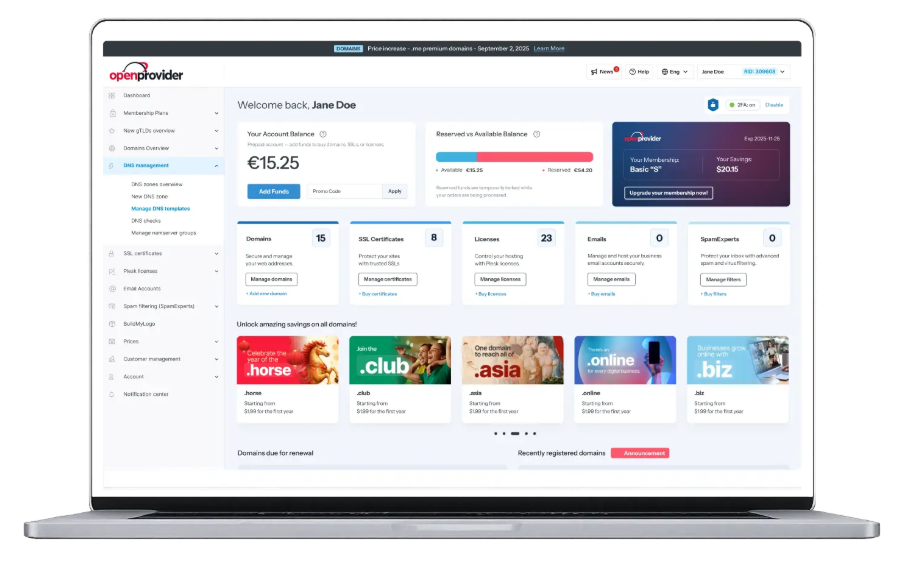
Openprovider: full white-label control via a backend integration that enables the custom Reseller Control Panel. You can send branded customer emails, and create custom DNS hostnames. There’s no mention of Openprovider in the customer experience.
Winner: Openprovider because it stays invisible behind your brand.
6. Upselling your customers

Namecheap: aggressively cross-sells hosting, VPN, business email, website builders, and SSL. Customers who buy domains through your API can still encounter Namecheap’s retail catalog.
Openprovider: provides a white-label experience for your customers. Your brand stays front and center and you keep the customer relationship.
Why it matters: every Namecheap upsell is revenue your platform could have earned, or a customer who may learn they can skip you entirely.
Winner: Openprovider, by design.
7. Bundle products at wholesale

Namecheap: hosting, SSL (four reseller tiers, $50 to $3,000+ in yearly spend), business email, and VPN.
Openprovider: offers SSL certificates through a Sectigo partnership starting at $6.99/year. Other products include Premium DNS, SpamExperts from €1.25/month, Plesk licenses, EasyDMARC, and business email. All are available through the same API and dashboard.
Winner: tied. Namecheap offers hosting that Openprovider does not. Openprovider goes deeper into domain-adjacent products. Pick based on what you sell.
8. Integrations: WHMCS, Plesk, and Blesta
Namecheap: an official WHMCS module exists, but it works more like a billing add-on than a full reseller integration. Plesk support is limited.
Openprovider: officially maintained modules for WHMCS, Plesk, Blesta, and HostBill, built for resellers running these platforms at scale.
Winner: Openprovider, with deeper, officially maintained integration coverage.
9. Compliance and security

Namecheap: ICANN-accredited. Free WHOIS privacy included. 2FA available.
Openprovider: ICANN-accredited, ISO 27001 certified, and NIS2-compliant. IP allowlisting at the API layer, 2FA, registry lock support, and built-in abuse monitoring.
Winner: Openprovider, with a stronger compliance posture.
10. Support for resellers
Namecheap: 24/7 live chat, strong for retail customers, less specialized for reseller technical issues.
Openprovider: 24/7 support in six languages: English, Dutch, Spanish, Catalan, Russian, and Hindi. The team specializes in reseller workflows: bulk migrations, API integration, and billing platform setup. Higher-tier members get a dedicated account manager, a real person, not a chatbot.
Winner: Openprovider, with reseller-specialized support.
That closes the category-by-category comparison and leads into the next section.
When Namecheap wins
Namecheap is the better choice in three scenarios:
You’re an individual domain owner.
Buying 1 to 5 domains for your own projects? Namecheap’s retail experience is cleaner and faster than Openprovider’s reseller-first platform. Free WHOIS privacy, an intuitive dashboard, and reasonable prices.
You want bundled hosting from one dashboard.
Namecheap offers shared hosting, VPS hosting, and managed WordPress hosting. Openprovider doesn’t. If you want one bill for domain and hosting, Namecheap wins.
You manage under 20 domains and don’t plan to grow.
Openprovider Membership pays off once the portfolio size crosses a certain threshold. Below 20 domains, Namecheap’s retail model has little downside for you.
When Openprovider wins (and it’s most of the time)
Pick Openprovider if you’re:
- Running a web agency, design studio, or digital agency
- A hosting company adding domain reselling
- An MSP or IT services firm managing client portfolios
- A SaaS platform embedding domain registration in your product
- A creator-economy or website-builder company
- Managing 50+ domains today, or planning to within 12 to 24 months
- A developer who won’t build on an XML-only API
- A reseller serving international customers who need ccTLDs
Namecheap vs Openprovider real cost comparison over 5 years
Here’s a hypothetical Namecheap vs Openprovider cost breakdown for an agency managing 500 .com domains over 5 years.
| Metric | Namecheap | Openprovider Basic S Membership |
| .com registration price | $10.98 | $10.44 |
| .com renewal price (year 2 to 5) | $18.48/year (a 68.3% increase) | $10.44 year (cost-price applies to renewals too) |
| Membership fee | $0 | $4.99/year |
| Year 1 total (500 domains) | $5.490 | $5,220 + $4.99 = $5,224.99 |
| Five-year total (500 domains, 4 renewal years) | $42,450 | $26,124.95 |
| 5 year net savings (after membership fee) | $0 | $16,325.05 |
SSL, email, and DNS bundle discounts widen the gap further, though we have not modeled that part. Treat this as directional, not a hard figure.
Final verdict: Openprovider wins over Namecheap for domain reselling in 2026
Openprovider wins most categories. Namecheap comes out ahead in the individual-buyer UX and bundled hosting.
The core finding is simple. Namecheap doesn’t claim to be a reseller platform. Its own documentation says so. Namecheap is a strong retail registrar with API access. Openprovider is a dedicated wholesale reseller platform.
If you’re an individual buyer registering 1 to 5 domains, Namecheap is fine. If you’re reselling domains at any real scale, Openprovider is the clear answer. No hidden fees, no retail markups, and no renewal fee surprises.
Ready to unlock true cost-price domains with no hidden fees? Compare membership plans right away.
Frequently Asked Questions
Is Namecheap a domain reseller platform?
No. Namecheap confirms this directly. Per its own knowledge base: “Currently, we do not have a domain reseller program. Still, you can resell domains with us using our API.” Namecheap is a retail registrar with API access, not a dedicated reseller platform.
Is Openprovider better than Namecheap for resellers?
Yes. Openprovider was founded in 2004 for resellers. It offers cost-price domains on 2,000+ TLDs through its membership model, a REST and JSON API, white-labeled bundled products, and no upselling to your customers. Namecheap’s reseller option is API access on a retail-priced backend, with tighter rate limits and an XML-only format.
What’s the cheapest way to resell domains right now?
Openprovider Membership, which unlocks 2,000+ domain extensions at registry cost and a robust API built for bulk automation. Membership plans start from only $4.99/year.
Can I resell Namecheap domains with WHMCS?
Yes. Namecheap offers a WHMCS module to bill your customers for domains. But Namecheap states plainly that it has no domain reseller program, only API access. For a fuller WHMCS reseller setup with cost-price domains and custom checkout, Openprovider’s WHMCS module goes further.
Does Openprovider offer hosting like Namecheap?
No. Openprovider focuses on domains and domain-adjacent products: SSL certificates, Premium DNS, SpamExperts, Plesk licenses, business email, and EasyDMARC. If you need bundled web hosting, pair Openprovider’s domain reselling with a separate hosting reseller program.
Does Openprovider support AI agents through MCP?
Yes. Openprovider runs an official MCP server that lets AI assistants like Claude check availability, register domains, edit DNS, and order SSL certificates through plain-language requests. Namecheap has no official equivalent. Available MCP servers are third-party projects built on its public API.