

Introduction – Targeting the right email service provider
This content has been updated with refreshed information as of November 2026
Choosing between email providers comes down to storage, security, custom domain support and price.” Keep the rest of the intro.
With increasing concerns about security, compliance, automation, and domain branding, domain resellers, web hosting providers, and digital agencies must choose their email platform over more than just inbox space.
In fact, modern tools empower users with custom domain capabilities, white-label options, robust deliverability rates, enhanced spam protection, and scalable infrastructure.
This guide ranks and compares the 10 best email service providers based on features, reliability, and customer reviews around the web.
What to look for in an email service provider
With hundreds of email service providers (ESPs) on the market, narrowing down the options requires a clear understanding of what drives performance, efficiency, and long-term value.
Here are the most important features and qualities to evaluate:
1. Custom domain support
Domain and web service resellers know that sending emails from a generic domain like @gmail.com doesn’t cut it: representing the digital identity of the brand and accessing advanced security features are the essentials to generate trustworthiness for a business.
2. Deliverability and spam filtering
It doesn’t matter how great your message is if it ends up in the spam folder.
The best ESPs maintain excellent sender reputations, enforce industry standards like SPF, DKIM, and DMARC, and offer robust filtering systems that ensure your emails reach inboxes.
3. Security and compliance
Whether you’re managing client data or handling sensitive internal communications, security is non-negotiable.
Look for providers offering S/MIME encryption and digital signatures, two-factor authentication (2FA), GDPR compliance, Single Sign-On (SSO), and advanced anti-phishing measures.
4. Ease of use and scalability
Usability matters.
A good email provider should offer a clean interface, easy setup, and admin features that scale with your business, such as role management, shared mailboxes, and user-level permissions.
5. Integration and automation capabilities
Tech-savvy businesses get how useful it is to integrate the existing tech stack with other tools, and provisioning systems like WHMCS.
6. White-label options for resellers
If you’re reselling services under your own brand, white-label email solutions are a must. They enable you to offer professional-grade email services while maintaining full control over your customer experience.
7. Reliable support and documentation
Whether it’s onboarding assistance or resolving a technical glitch, responsive support makes a big difference.
The top ESPs back their offerings with well-maintained documentation, user guides, and responsive support teams that understand the needs of hosting companies, agencies, and IT professionals.
In the next section, we’ll walk you through the top email service providers of 2026, covering their features and who they’re best suited for.
TL;DR: the top 10 email providers compared
| Name | Mailbox size | Ideal for | Multiple domains | Email aliases | Free plan | Paid from (per user/month) |
| Openprovider Mail | Custom, starting from 15GB | Domain service resellers, hosting providers and agencies | ✅ Yes | Unlimited aliases per mailbox (reseller-configurable) | ❌ No (free trial) | $0.70 per mailbox (reseller price) |
| Gmail (Google Workspace) | 30 GB – 5 TB (plan-dependent) | SMEs, remote teams, solo professionals | ✅ Yes | Up to 30 aliases per user | ✅ Yes (personal, no custom domain) | $7 (Business Starter) |
| Outlook (Microsoft 365) | 50 GB – 100 GB (archive up to 1.5 TB) | Enterprises, hybrid workplace teams | ✅ Yes | Up to 400 aliases per user | ✅ Yes (personal, no custom domain) | $4 (Exchange Online Plan 1) |
| Proton Mail | 15 GB – 3 TB (shared with Proton Drive) | Privacy-focused users & small teams | ✅ Yes (on paid plans) | 10–20 addresses per user (plan-dependent) | ✅ Yes (personal, no custom domain) | $6.99 (Mail Essentials) |
| iCloud Mail | 5 GB – 12 TB (with iCloud+) | Apple users and solopreneurs | ❌ No | 3 aliases | ✅ Yes (5 GB, no custom domain) | $0.99 per account (iCloud+ 50 GB, custom domain included) |
| Zoho Mail | 5 GB – 100 GB | SMBs and tech-forward agencies | ✅ Yes | Up to 30 aliases per user | ✅ Yes (up to 5 users, custom domain included) | $1 / €0.90 (Mail Lite) |
| Neo Mail | 10 GB – 100 GB | Solopreneurs, freelancers, startups | ✅ Yes (on paid plans) | 10–50 aliases (depending on plan) | ❌ No (15-day trial) | $2.49 (Business Starter) |
| Fastmail | 5 GB – 100 GB | Tech-savvy users, developers | ✅ Yes | Up to 600 aliases per account | ❌ No (30-day trial) | $3 (Basic); $5 with custom domain (Standard) |
| Tuta | 150 GB – 1 TB | Encrypted communication advocates | ✅ Yes (on paid plans) | 15–30 extra addresses per user, plus unlimited addresses on your own domain | ✅ Yes (1 GB, no custom domain) | €6 (Essential) |
| Mailfence | 10 GB – 60 GB | Compliance-focused professionals | ✅ Yes | 50–200 aliases (plan-dependent) | ✅ Yes (500 MB, no custom domain) | €2.50 (Base); €3.50 with custom domain (Entry) |
This guide was developed through in-depth market research and hands-on insights from Openprovider’s team of domain infrastructure experts, who support thousands of resellers, hosting providers, and digital agencies worldwide.
It aims to deliver a balanced and practical overview of the best email service providers of 2026, considering real-world needs such as scalability, white-label capabilities, and multi-domain management. Our goal is to help decision-makers in the domain services ecosystem make informed, business-driven choices, while recognizing the value each provider brings to the evolving email landscape.Openprovider business email is our own product, built for businesses that sell email to their clients.
A deep dive into the features of email service providers
Ideal for domain resellersMailbox storage: 15 GB per mailbox (+ 5GB expansion packs).
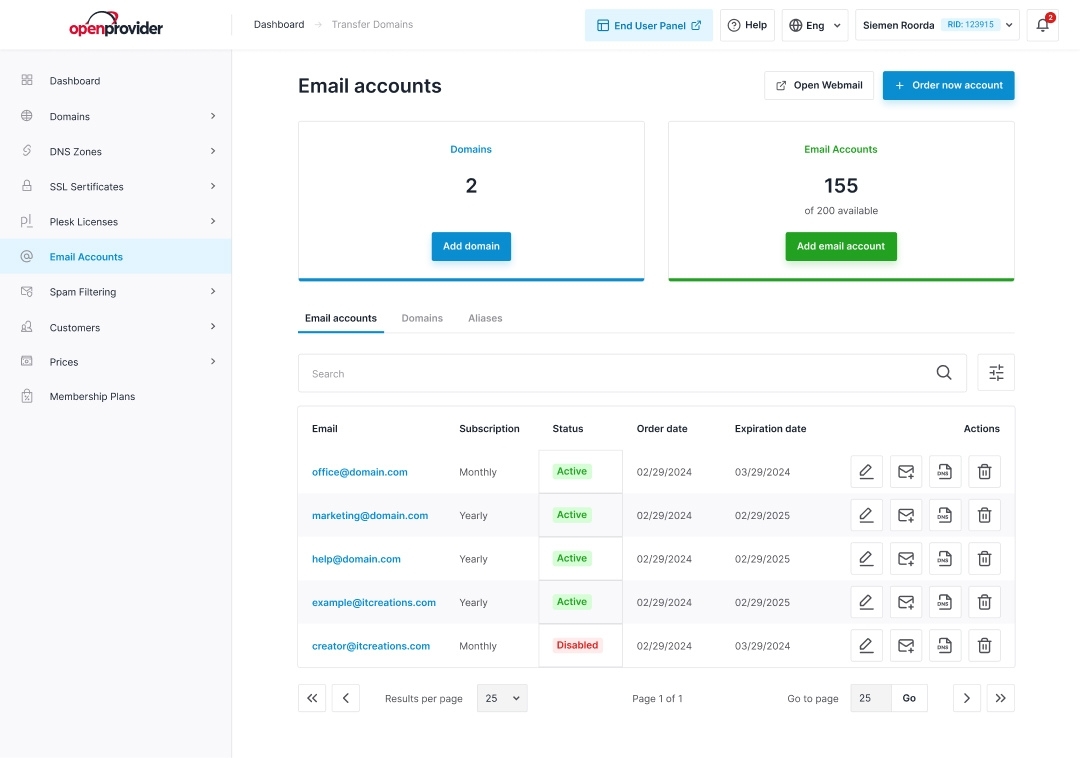
Openprovider business email solution is tailored for domain service resellers, offering scalable solutions with robust security features.
Features
- Unlimited aliases per mailbox
- Fully white labeled
- Support for multiple domains
- Advanced spam filtering
- No cap on number of inboxes
- Primarily designed for resellers
Best for Google workspace users
Mailbox storage: 5 GB or 10 GB (Mail Lite), 50 GB (Mail Premium), or up to 100 GB with Zoho Workplace Professional
Gmail is one of Google’s most popular products. It offers a user-friendly interface with robust integration into Google’s ecosystem, making it ideal for businesses already using Google services.
Pros:
- Strong spam protection
- Seamless integration with Google apps
- Reliable uptime
Cons:
- Privacy concerns due to data scanning
- Limited customization for advanced users
Best for Microsoft users
Mailbox storage: 50 GB (Exchange Online Plan 1) to 100 GB (Microsoft 365 Business Basic and Business Standard, Exchange Online Plan 2), plus up to 1.5 TB of archive storage on Exchange Online Plan 2
Outlook integrates deeply with Microsoft Office tools, offering a familiar environment for businesses reliant on Microsoft products.
Pros:
- Fluid collaboration across MIcrosoft’s apps
- Robust calendar and task management
- Advanced security features
- High attachment size limit
Cons:
- Can be resource-intensive and less scalable for medium-big businesses
- Complex setup for non-Windows users
The privacy-focused provider
Mailbox Storage: 15 GB (Mail Essentials), 1 TB (Workspace Standard) or 3 TB (Workspace Premium), shared across Proton Mail and Proton Drive
Proton Mail emphasizes security with end-to-end encryption, catering to users who prioritize privacy.
Pros:
- End-to-end encryption
- No personal information required for signup
- Open-source codebase
Cons:
- The user-based pricing for businesses may limit scalability
- Integrations might be more limited, and connectivity with other email clients is dependant on a secondary product (Proton Bridge)
Best for Apple users
Mailbox Storage: 5 GB – 12 TB (with iCloud+)
iCloud Mail is optimized for Apple devices, providing seamless synchronization across the Apple ecosystem.
Pros:
- Smooth integration with Apple devices
- User-friendly interface
- Generous and expandable storage
Cons:
- Not focused on businesses and resellers
- Limited customization and volume-capped messages
- Not ideal for non-Apple users
Feature-rich for businesses
Mailbox Storage: 5 GB, 10 GB or 50 GB (plan-dependent)
Zoho Mail offers a comprehensive suite of tools tailored for businesses, including CRM integration and collaboration features.
Pros:
- Ad-free experience
- Integrated with Zoho’s suite of apps
- RevOps-focused, with strong administrative controls
Cons:
- Learning curve for new users
- Not reseller-focused
- Full potential reached better when connected to other Zoho’s tools
Ideal for small teams
Mailbox Storage: 15 GB (only 5 are cloud) to 100 GB (plan-dependent)
Neo Mail focuses on simplicity and efficiency, making it suitable for startups and small teams seeking straightforward email solutions.
Pros:
- Clean and intuitive interface
- Affordable pricing
- Custom domain support
Cons:
- Limited advanced features
- Smaller user community
Speed and simplicity
Mailbox Storage: 5 GB (Business Basic), 50 GB (Business Standard) or 100 GB (Business Professional) of mail storage
Fastmail offers a fast, no-frills email experience with a focus on user privacy and minimalism.
Pros:
- Offers a free trial
- Market-aligned pricing
Cons:
- Limited integrations
- Reports on missing end-to-end and PGP encryption
- Smaller user community
Secure and open-source
Mailbox Storage: 50 GB (Essential), 500 GB (Advanced) or 1 TB (Unlimited)
Tutanota provides encrypted email services with a commitment to open-source development and user privacy.
Pros:
- End-to-end encryption
- Offers autoresponders and secure web embeddings
Cons:
- Limited third-party integrations
- Limited-to-no IMAP/POP support
Privacy with productivity
Mailbox Storage: 10 GB (Entry) to 60 GB (Ultra) of email storage, or 40–225 GB in total including document storage. Custom domains start on the Entry plan.
Mailfence combines secure email with productivity tools like calendars and document storage, targeting privacy-conscious professionals.
Pros:
- Digital signatures support
- Integrated suite of tools
- No ads
Cons:
- Limited storage on free plan
- Recipient-based limitations
- Interface can feel dated
Other popular email providers
Some of the most popular email providers didn’t make our list because they’re built for personal use rather than business. Yahoo Mail and AOL Mail are long-standing free services, still common in the US.
In Germany, GMX and WEB.DE are among the most used email providers, and mail.com, run by the same group (United Internet), lets you pick from a long list of ready-made address endings. They work well for personal mail, but for an address on your own domain, choose one of the business email providers above.
Business email providers for resellers, hosting companies and agencies
If you run a hosting company, an MSP or an agency, you will have to make a choice on which email platform you can sell and support across hundreds of client domains.
Consumer and suite providers bill each user directly, so the client relationship usually stays in the hands of the end client, which is unprofessional and create more friction than necessary.
A white-label business email platform lets you create mailboxes on your clients’ domains, set your own price and keep support under your brand.
Openprovider business email is built for that model: 15 GB mailboxes with 5 GB expansion packs, spam filtering and multi-domain support, managed from the same control panel as your domains.
FAQ on the top email providers
What are the best email providers in 2026?
For most businesses, Gmail (Google Workspace) and Outlook (Microsoft 365) are the safest all-round choices. Proton Mail and Tuta lead on privacy, Zoho Mail on value for small teams, and Openprovider Mail on white-label email for resellers and hosting providers.
What email providers are there?
There are four main types: free personal providers (Gmail, Outlook.com, Yahoo Mail, iCloud Mail), privacy-first providers (Proton Mail, Tuta, Mailfence), business suites (Google Workspace, Microsoft 365, Zoho Mail), and white-label platforms that hosting companies and agencies sell under their own brand.
What is the difference between an email provider and an email service provider (ESP)?
An email provider hosts your mailboxes so you can send and receive messages, like Gmail or Outlook. In email marketing, “ESP” usually means a bulk or transactional sending platform, like Mailchimp or SendGrid. This guide compares mailbox providers.
Which email provider is best for a business with its own domain?
Choose one that supports custom domains plus SPF, DKIM and DMARC, then decide by team size, the office suite you already use, and price per mailbox. Agencies and hosting companies managing client domains should look at a white-label platform instead.
Can I resell email hosting to my clients?
Yes. A reseller or white-label email platform lets you create mailboxes on client domains, set your own prices and support clients under your brand. Openprovider Mail is built for this and is managed alongside your domains.
Conclusions – Select your email service provider
Choosing the right email service provider in 2026 is about finding a solution that matches your business model, security needs, and growth plan, rather than mere mailbox size or user interface.
Openprovider offers tailored capabilities that give resellers and agencies a clear edge to keep offering to their clients manageable and scalable digital services.
Learn more on why resellers across the globe have already chosen our business email solutions.