
The best domain reseller API overall in 2026 is the Openprovider REST API. It gives resellers access to 2,000+ TLDs at wholesale prices through Memberships: no retail markup, no vendor lock-in, no separate SSL integration. You can register, renew, and transfer domains from one API, alongside SSL and other domain services.
This guide compares the best reseller APIs, including decent options like Name.com and OpenSRS. We cover endpoint coverage, REST design quality, TLD count, rate limits, SDK availability, sandbox environments, and wholesale pricing.
If you’re building a hosting platform, a SaaS site builder, a creator tool, or an AI agent that registers domains on behalf of users, the API you choose decides your unit economics, your uptime, and your TLD reach. Pick the wrong one, and you’re rebuilding the integration in 18 months.
Here’s how the top 5 reseller APIs compare.
What is a domain reseller API?
A domain reseller API is a programmatic interface, typically REST or XML over HTTPS, that lets developers register, renew, transfer, and manage domains through a registrar’s infrastructure under their own brand.
With one, you can check availability, register domains, manage DNS records, configure nameservers, and handle WHOIS privacy without an ICANN accreditation of your own. Becoming an ICANN-accredited registrar takes significant liquid capital and ongoing compliance work, so most platforms build on a reseller API instead.
APIs matter more than dashboards. Whether you’re registering 1 domain or 10,000, the API call doesn’t change.
How we tested the 5 best domain reseller APIs
We evaluated each API against ten criteria that determine whether an integration holds up in production, not just in a demo. Every criterion was checked against each provider’s own developer documentation.
1. REST design quality
Whether the API is JSON-first, backed by a published OpenAPI or Swagger spec, and organized around a predictable endpoint structure.
2. Authentication
Support for bearer tokens or OAuth, the ability to rotate API keys, and IP allowlisting for production safety.
3. TLD coverage
Total number of supported TLDs, with attention to ccTLD depth for resellers serving international customers.
4. Sandbox environment
Whether you can test registrations, transfers, and renewals without spending real money before going live.
5. SDK availability
Official or actively maintained client libraries in common languages like Python, Node.js, PHP, and Go.
6. WHMCS, Plesk, and Blesta integrations
Whether pre-built, officially maintained modules exist, rather than relying on community-built ones.
7. Webhook support
Whether the API pushes async event notifications for things like renewals, transfers, and expirations, instead of requiring you to poll for status changes.
8. Wholesale pricing model
Whether pricing is wholesale price, tiered by volume, or a fixed markup over registry cost, since this determines your margin ceiling as you scale.
9. Docs quality
Whether documentation includes working examples, a full error code catalog, and real sample responses, not just endpoint lists.
10. Uptime SLA: Whether the provider publishes a formal uptime guarantee, or only makes informal reliability claims.
Domain reseller APIs quick comparison
| Rank | API | Best For | Protocol | OpenAPI Spec | TLDs | Sandbox | WHMCS | Pricing |
| 1 | Openprovider REST API | Resellers,agencies, MSPs | REST, JSON | ✅ | 2,000+ | ✅ | ✅ | Wholesale pricing(Membership) |
| 2 | OpenSRS API | Shopify & Hover-scale platforms | XML | ✖ | 730+ | ✅ | ✅ | Tiered |
| 3 | Name.com API | AI-agent workflows, modern dev stacks | REST, JSON | ✅ | 600+ | ✅ | ✅ | Tiered |
| 4 | GoDaddy Reseller API | US consumer-facing apps | REST, JSON | ✅ | 500 | ✅ | ✅ | Tiered |
| 5 | DomainNameAPI | Small resellers wanting fast setup | REST and SOAP | Partial | 850+ | ✅ | Yes | Tiered |
1. Openprovider REST API: best overall
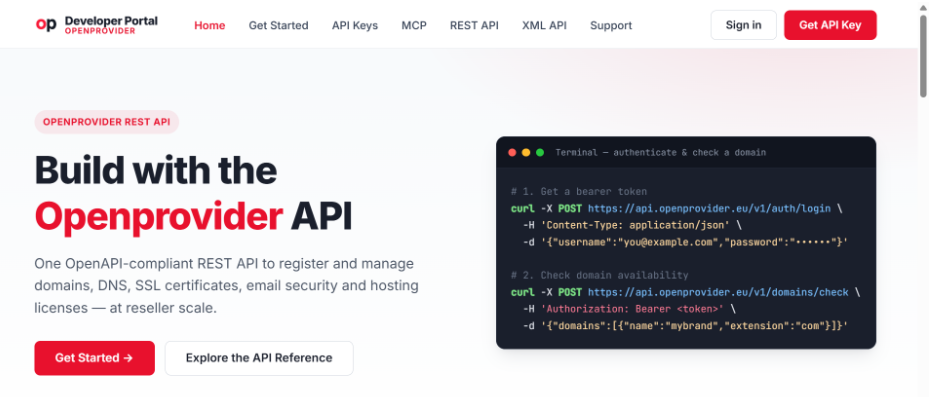
Openprovider’s REST API, trusted by 10,000+ resellers. It offers domains at wholesale price and manages over 4 million domains across 126+ countries via a single endpoint. The same base URL and authentication also cover SSL certificates, email hosting, EasyDMARC, and software licenses. We’re building an MCP (Model Context Protocol) server — so AI agents can interact with domain services using natural language. No manual API calls required.
A public sandbox lets you test registrations before going live.
Openprovider sandbox
Openprovider provides a sandbox where resellers can test API and Reseller Control Panel operations. You can do this without buying real domains or products.
Use it to validate registrations, transfers, renewals, and other workflows before going live. The sandbox lets you test without affecting production data or incurring real charges.
Explore the Openprovider sandbox.
Why it’s #1:
- OpenAPI-spec REST API with a full sandbox and importable spec for Postman or client code generation
- MCP server lets AI assistants like Claude manage domains, DNS, and SSL certificates with plain-language requests using your authenticated account.
- 2,000+ supported TLDs, the widest catalog of any API on this list
- Wholesale price domains through Memberships, so you pay what Openprovider pays the registry
- Sandbox environment for free testing
- Official WHMCS, Plesk, Blesta, and HostBill modules maintained by Openprovider
- IP allowlisting + 2FA at the API auth layer
- An EPP gateway available alongside REST for teams migrating from legacy registrars
- Full automation in one API: domains, DNS, WHOIS, SSL, email, and licenses
“With Openprovider, we can fully automate their services into our workflows, giving us more time for us to focus on our own core business. We also love their very attractive price points.”
Mike van Pamelen, CEO of Kentivo
Pros
- Largest TLD catalog 2,000+
- True wholesale price via Membership (no markup games)
- Production-grade scale API
- AI-agent ready via MCP server, in addition to the REST API
- Same API runs Openprovider’s own platform = stability guarantee
- Full automation: bulk register, bulk transfer, DNS, WHOIS, SSL, email — one API
- No retail brand competing for your customers
Cons
- Reseller Control Panel has a learning curve for complex workflows
- Requires prepaid funds in your account to buy domains (checking domains is free)
- Strict API call limits on certain calls can frustrate heavy users
Choose Openprovider if you want a battle-tested, purpose-built REST API that unlocks 2,000+ domains at wholesale price and automates daily operations for resellers and agencies.
2. OpenSRS API: best for enterprise-scale platforms
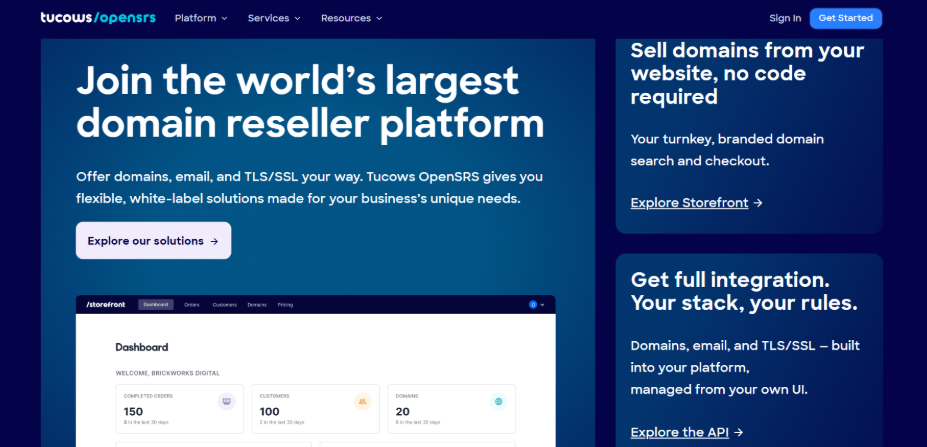
OpenSRS is a Tucows-owned wholesale registrar that powers Shopify, Hover, and thousands of other massive platforms. OpenSRS plugs easily into major hosting and billing software like WHMCS, HostBill, and ClientExec. However, the platform’s documentation states plainly that the API is based on XML, not REST or JSON. This means slower parsing speeds and higher implementation complexity than modern REST-first APIs on this list.
Pros
- Solid choice for massive Shopify-scale platforms
- 730+ TLD coverage
- Comprehensive documentation and API guides
- White-label DNS and email through the same API
Cons
- XML legacy endpoints feel dated next to REST-first competitors
- Tier-based pricing (small resellers pay more)
- Setup is less developer-friendly than REST-first competitors
- MD-5-signed auth plus mandatory IP allowlisting is a dated security posture (Openprovider offers IP allowlisting as a feature)
Choose OpenSRS if you’re building at Shopify-scale and proven uptime matters more than a modern REST interface.
3. Name.com API: best for SaaS platforms
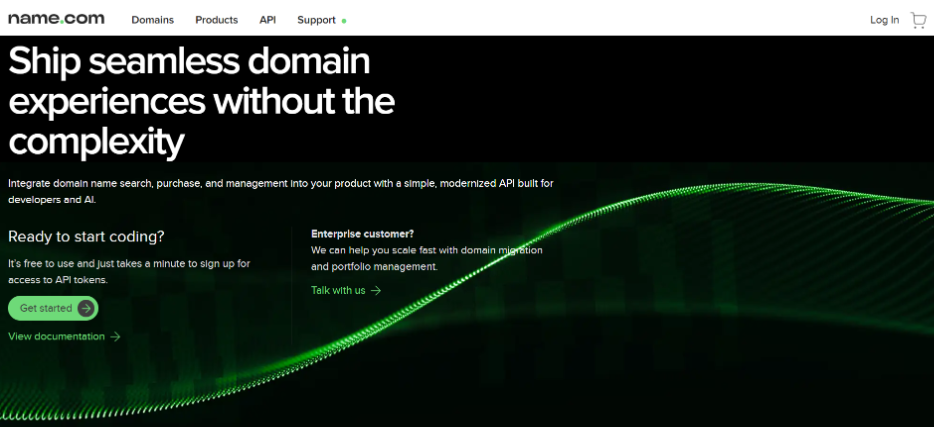
Name.com rebuilt its API around what it calls a Core API, and it now ships a live experimental MCP server. The server lets AI agents like Claude and Cursor register and manage domains through natural-language tool calls, without manual input. Name.com’s API lets you automatically check domain availability, view prices, configure DNS settings, and manage domain renewals. The underlying REST API is OpenAPI-documented.
Pros
- Supports 600+ domain extensions
- Clean OpenAPI-documented REST
- You can register a domain using your AI agent
- The MCP server automates common reseller workflows
Cons
- Smaller TLD catalog compared to most competitors in this list
- Limited European ccTLD depth
- Smaller established reseller community than Openprovider or OpenSRS
Choose Name.com if you’re building a modern SaaS product and want a clean, OpenAPI-documented REST API to build on.
4. GoDaddy Reseller API: best for US Consumer-facing apps

GoDaddy’s API, backed by the world’s largest registrar brand, spans two eras at once. Newer Domains v3 endpoints use a Personal Access Token (PAT) and an OpenAPI spec ready for AI coding assistants. Older endpoints still run on the legacy SSO-key method. An OTE sandbox supports testing, and standard keys are capped at 60 requests per minute.
Pros
- Massive brand recognition with US end users
- Polished REST, OpenAPI-based v3 endpoints
- Good docs with interactive reference tools
- OTE (Operational Test Environment) for sandbox.
Cons
- Higher wholesale pricing than Openprovider
- Tier-based discounts
- GoDaddy upsells to your customers in some flows
Choose GoDaddy if your customers are US clients mostly offering consumer-facing applications.
5. Domain Name API: best for small resellers wanting fast setup
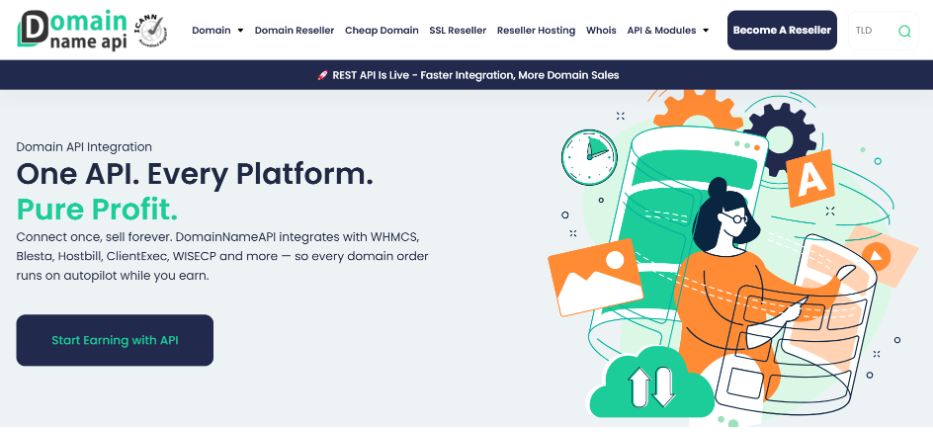
Domain Name API is a Turkey-based reseller API with low signup friction and broad billing-platform integration. The platform supports both REST and SOAP, plus eight free integrations with the billing platforms resellers already run on. With over 800 extensions on offer, Domain Name API gives your customers a wider choice.
Pros:
- Free WHMCS, HostBill, HostFact, Upmind, WISECP, and ClientExec modules
- No minimum deposit required to join
- Sub-reseller panels included.
- Good for emerging-market agencies.
Cons
- Fewer TLDs than the leading resellers
- Less proven at enterprise volume
- Tiered pricing model reduces margins for small resellers
Choose DomainNameAPI if you’re a small fledgling agency and want plug-and-play billing integrations without a long setup process.
How to start using a domain reseller API
The steps vary between providers, especially around account setup and API access. In general, you’ll need to:
- Create a free reseller account.
- Fund a prepaid balance, since most of these APIs deduct costs as you register domains.
- Generate API credentials from the reseller control panel.
- Test in the sandbox before touching production, whether that’s Openprovider’s OT&E, OpenSRS’s Horizon, or GoDaddy’s OTE environment.
- Install a WHMCS, Blesta, or HostBill module if you’re already running a billing platform, since a pre-built module can cut weeks off the integration.
- Go live with rate-limit-aware production traffic once your sandbox tests pass.
Get started with Openprovider’s REST API for just $4.99 for Basic S Membership, and buy domains at wholesale price with full API automation.
Which domain reseller API is right for you?
For a production reseller platform, the widest TLD catalog, and genuine wholesale pricing, Openprovider’s REST API is the strongest starting point.
Teams prioritizing uptime at extreme scale will find OpenSRS has the deepest track record. Those building AI-agent or LLM-powered tools now have a real choice: Name.com‘s experimental MCP server or Openprovider’s MCP server. Openprovider pairs AI-agent access with the widest TLD catalog. GoDaddy carries the strongest US consumer brand recognition, while DomainNameAPI works best for small agencies wanting fast setup and the broadest set of free billing modules.
Ready to unlock domains at cost price? Explore Openprovider’s reseller REST API to get started.
Frequently asked questions
What is the best domain reseller API?
The Openprovider REST API is the strongest overall choice, with an OpenAPI-spec compliant design, 2,000+ TLDs, and wholesale price domains through Memberships. Other APIs may suit specific use cases, depending on your technical setup, required features, or business model.
Is there a free domain reseller API?
Yes. Openprovider, OpenSRS, Name.com, and DomainNameAPI all offer free reseller account signup with API access. You pay only for the domains and products you register.
Do I need to be an ICANN-accredited registrar to use a reseller API?
No. A reseller API lets you sell domains under your own brand using an existing registrar’s accreditation, without the capital requirements or ongoing compliance work of accreditation yourself.
Which domain reseller API has the most TLDs?
Openprovider, with 2,000+ supported TLDs, has the widest coverage, ahead of Domain Name API’s 800+, OpenSRS’s 730+, and Name.com’s 600+.
Can AI agents register domains through an API?
Yes. Openprovider has a live MCP server that lets AI agents register and manage domains through natural-language tool calls.