
Key takeaways
- Chile is the fifth largest ecommerce market in Latin America with the highest per capita online spend, and the highest per capita online spend, 94.1% internet penetration, and 82.8% of digital transactions going to domestic sites, so a local domain materially affects where clients win.
- A .CL domain is a trust and local SEO signal that a .com cannot match inside Chile, where .CL usage already exceeds .com.
- .CL is openly registrable with no local presence required for the base case, but carries a two-year minimum term and shifting eligibility guidance, so verify current NIC Chile rules before quoting.
- Consolidating .CL plus SSL, DNS, and email on Openprovider at registry-cost Membership pricing protects margin and turns a single sale into recurring revenue.
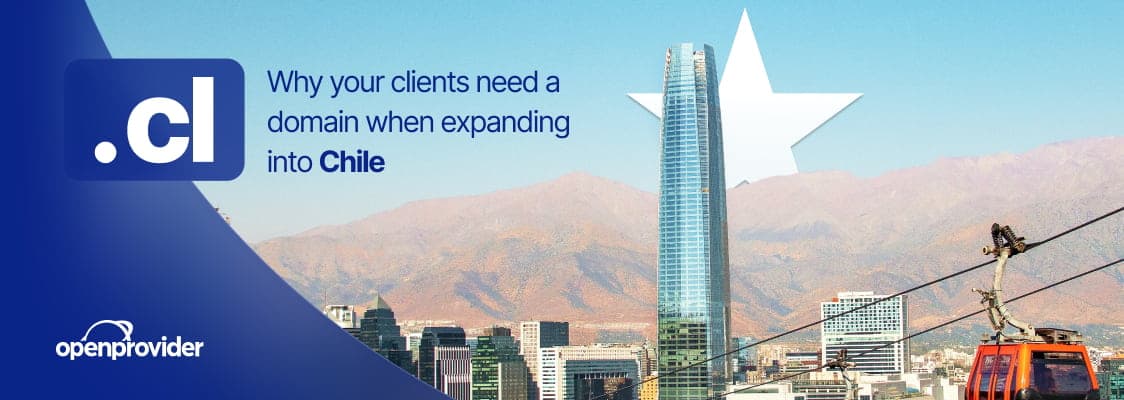
When a client tells you they’re expanding into Chile, the domain conversation usually defaults to habit: register the .com, point it at a landing page, move on.
For any reseller building a serious Latin America TLD offering, the opportunity to resell .CL domains is one of the clearer cases where the local ccTLD, not the global default, is the right recommendation, and where saying so positions you as an advisor rather than an order-taker.
Chile is not a speculative bet. It has the highest per capita ecommerce spend in Latin America and, at the start of 2025, internet penetration of 94.1%, one of the highest rates in the region.
Chilean consumers also show a measurable preference for buying from domestic sites over international ones.
This article is written for the conversation you’ll have with your clients.
We’ll cover why Chile is worth prioritizing, what a .CL domain does that a .com can’t in this specific market, the registration requirements you need to get right before you quote, and how adding .CL to your portfolio through Openprovider fits into the recurring revenue you already manage. The goal is simple: give you enough market context and operational detail to recommend .CL with confidence, and to fold it into your stack without friction.
Why Chile is one of the highest-value digital markets in Latin America
With a population of only around 19 million, Chile still ranks as the fifth largest ecommerce market in the region, driven by the highest per capita ecommerce consumption in Latin America.
For a client weighing where to plant their first regional foothold, that ratio matters more than raw population. It signals a market where shoppers are already comfortable transacting online and have the disposable income to do it repeatedly.
The behavioral data backs this up. Roughly 90% of Chilean adults shop online, and mobile devices now account for around 59% of ecommerce volume. Ecommerce in Chile generated about $11.5 billion in 2024, growing eight percent while physical commerce grew only four percent, with projections pointing toward continued double-digit growth.
There’s one statistic that should reframe the whole domain decision, though.
Between January and September 2024, 82.8% of digital transactions in Chile were made on domestic websites, versus 17.2% on international sites.
That split reflects how Chilean consumers evaluate trust, and it points directly at the next question your client needs answered: what actually makes a store read as local.
.CL vs .com: why local wins
The honest answer is that a .com will function perfectly well in Chile. It will have wide recognition, it will host a store, and it will take payments. But a .CL domain tells a Chilean shopper, a local search engine, and a payment provider that this business is here, operating in their market, subject to their expectations.
Search behavior compounds the effect. Local ccTLDs carry weight in country-specific ranking, so a .CL site competing for Chilean queries starts with an advantage that no amount of .com content can fully offset.
NIC Chile itself reports that .CL usage exceeds .com usage inside the country, which means your client’s competitors are very likely already on .CL.
For domain resellers, this is the moment to move the client from “just get us online” to “get us positioned.”
Recommending .CL as the primary domain, with a .com registered defensively alongside it, is a more sophisticated posture than either alone. It protects the brand, aligns with how the market actually searches and buys, and gives you a natural reason to bundle registration, DNS, and security into a single managed setup rather than a one-off domain sale.
The registration mechanics behind that recommendation are where most of the friction hides, so those come next.
.CL domain registration: requirements resellers need to know
Here’s where .CL stops behaving like a typical ccTLD, and where getting the details right protects your client relationship.
Since December 2013, .CL has been open for registration. The old requirement that foreign registrants supply a local contact with a Chilean national ID was eliminated, so any individual or company can register a .CL domain from anywhere in the world. No local presence, no local entity, no in-country intermediary required for the base case.
The one detail that trips up resellers pricing .CL is the term.
Unlike most gTLDs that offer annual registration, .CL carries a minimum registration period of two years. So, you’re not selling a one-year renewal cycle, and the client’s upfront cost and your renewal reminder schedule both shift accordingly.
Furthermore, .CL has supported DNSSEC since 2011, so you can position it as a modern, secure ccTLD for clients with real security requirements rather than a legacy extension.
Pro reseller tip
Factor it into the proposal from the start rather than surprising the client at checkout.
The reseller opportunity: .CL as a gateway to the Chilean market
Step back from the single domain and the commercial logic gets clearer.
A client entering the Chile market doesn’t need a domain. They need a working digital foundation: the right domain, DNS that resolves reliably, an SSL certificate the browser and the shopper both accept, email that authenticates and lands, and a security posture that holds up. The .CL registration is the entry point to all of it, which means it’s also your entry point to a multi-product, recurring relationship instead of a single transaction.
This is where fragmentation erodes margin.
If you register the .CL through one vendor, buy the certificate somewhere else, and run email through a third, every renewal becomes a separate reconciliation, every support question a separate portal, and every lapse a separate risk to your client’s uptime.
A missed .CL renewal on a two-year cycle is easy to overlook precisely because it’s infrequent, and a lapse on a client’s primary Chilean domain is the kind of failure that ends relationships.
So, consolidating your domain stack is how you keep the cost-to-serve low enough that the account stays profitable across its full lifetime.
Positioned this way, Chile becomes a template rather than a one-off.
The same playbook of local ccTLD supporting API domain infrastructure applies to any market your clients expand into, and the reseller who runs it from a single platform builds switching costs into every account they touch.
That’s the difference between selling domains and owning the digital infrastructure a client depends on, and it’s the foundation the final section builds on.
How to add .CL to your reseller portfolio on Openprovider
The guiding principle here is simple: control over the full stack is what turns a single .CL sale into a durable client relationship. A registrar that only hands you the domain leaves you assembling the rest from separate vendors, and every seam in that assembly is a place where margin leaks and risk accumulates.
Consolidating the .CL and everything around it on one platform is what makes the Chile play repeatable rather than a favor you did once.
On Openprovider, .CL sits inside the same Reseller Control Panel you already use to manage the rest of your portfolio, so there’s no separate accreditation project or parallel workflow to maintain. You register the domain, configure DNS, attach an SSL certificate, and set up authenticated business email from the same interface, and the whole setup renews on schedule instead of scattering across renewal dates you have to track by hand.
For resellers running WHMCS or a custom portal, the same functions are available through the API, so .CL folds into automation you’ve already built.
The economics reward this consolidation directly.
An Openprovider Membership gives you domains at registry cost with no hidden markup, which matters more than usual on .CL because of that two-year minimum term: you’re quoting a larger upfront figure, so the difference between wholesale and marked-up pricing is more visible to the client and more consequential to your margin.
Predictable registry-level pricing lets you build the Chile bundle once, price it with confidence, and repeat it for every client entering the market without renegotiating your own cost base each time.
That repeatability is the real product. A client entering Chile doesn’t just need a domain registered. They need a foundation that holds, and the reseller who owns that foundation earns the renewals, the cross-sells, and the next market expansion too.
Turning a market opportunity into recurring revenue
Chile rewards resellers who treat domain selection as strategy rather than default. The market is large, mature, and measurably biased toward local sites, which means the .CL recommendation is one of the clearest ways to demonstrate to a client that you understand where they’re actually competing.
The durable advantage comes from what sits underneath the recommendation. When the .CL domain, its DNS, its certificate, and its email all live on one platform at transparent registry pricing, you protect your margin across the full two-year cycle, reduce the operational load of managing the account, and make yourself harder to replace with each service the client depends on. Transparent pricing turns into predictable revenue, and consolidated infrastructure turns a one-time sale into a relationship that renews.
Chile is the template. Run it well once and the same approach carries into every market your clients expand into next. If you want to build that foundation, you can start with a free Openprovider account and add .cl to your portfolio today.