
Autonomy is freedom. In the age of overwhelming big tech dominance, it has never been so valuable. So when a small ISP in the Netherlands operates without relying on public clouds or big tech, owns its own hardware and runs its own network, that’s already a statement.
Add to that developing its own software control panels, and it’s clear that security, privacy, autonomy, and sovereignty are much more than a philosophy.
In that sense, choosing Openprovider as a supplier and dependency is a very deliberate choice.
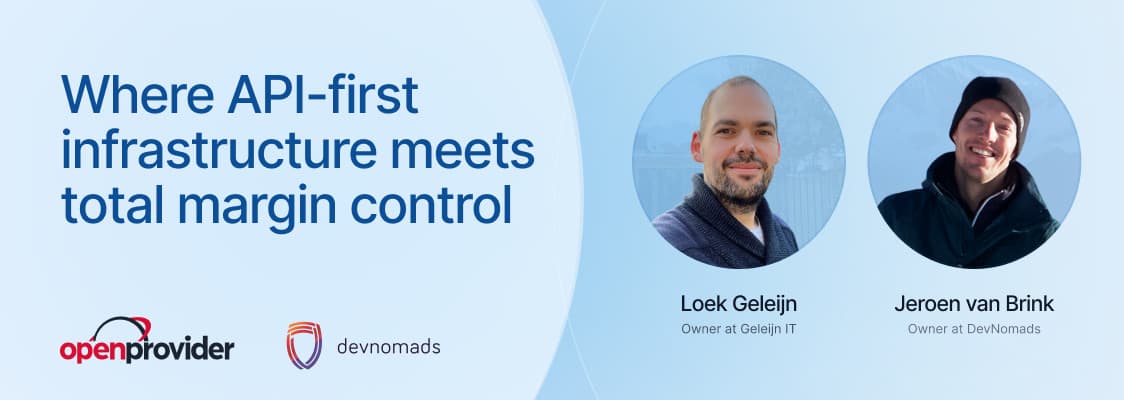
Founded in Middelburg, the Netherlands, DevNomads has spent more than 15 years building a reputation as a full-service digital infrastructure provider, specializing in managed web hosting, web applications, email and domain management, and consultancy.
In a hosting market increasingly shaped by acquisition and price inflation, DevNomads – a four-man operation – has chosen to differentiate themselves by focusing on transparent pricing, long-term B2B relationships, and a strong commitment to privacy and data control.
But for DevNomads, more than a talking point, transparency is a commercial position. And as this case study shows, it’s one that Openprovider helps make possible.
Turning transparent pricing into a competitive advantage
In recent years, large providers in the hosting market have been acquiring smaller players and raising prices, using the captured customer base to fund the next acquisition.
DevNomads knows they can’t compete with that kind of economies of scale – and they’re not trying to. Instead, the response has been deliberate: build long-term B2B relationships on a foundation of honest pricing and a cost structure where customers only pay for what they actually get.
But transparent pricing is only credible when there’s full cost base control. For a company like DevNomads, managing thousands of domains across 250 clients, that means knowing precisely what every domain costs to register and renew. And having the margin to price transparently without it becoming a commercial sacrifice. Without that foundation, the values don’t hold up commercially.
DevNomads didn’t get here by accident. It required domain infrastructure designed around exactly the same principles – and that’s where Openprovider came in.
Why domain infrastructure either supports growth or limits it
As DevNomads grew, so did the operational weight of managing domains across an expanding customer base.
New onboardings regularly involve inheriting entire domain portfolios – sometimes hundreds of domains at once. Each transfer needs to be fast, cost-neutral for the customer, and handled without pulling the team away from higher-value work.
For a small team like DevNomads, fragmented domain infrastructure or an unreliable registrar platform isn’t an option. They couldn’t afford to be buried in unnecessary support tickets, clients waiting too long for domains to go live, transfers that drag on, and domain admin that should never have needed manual attention in the first place.
That overhead wouldn’t stay flat as the client base grew. It would compound – and at a certain point, would become the ceiling on revenue.
DevNomads co-owner Loek Geleijn had already seen what the alternative looked like. Working across the industry before co-founding DevNomads, he’d encountered registrar platforms that created more problems than they solved.
Slow support response times, clunky transfer processes, poor follow-through on raised issues – the operational drag was something he had no intention of carrying into a business he was building from scratch.
The reason DevNomads chose Openprovider from day one, and has never needed to look elsewhere, comes down to two things: a full-featured API and competitive pricing.
One platform, full lifecycle control, less time on administration
For a small team managing a growing portfolio, growth at scale is only possible through automation.
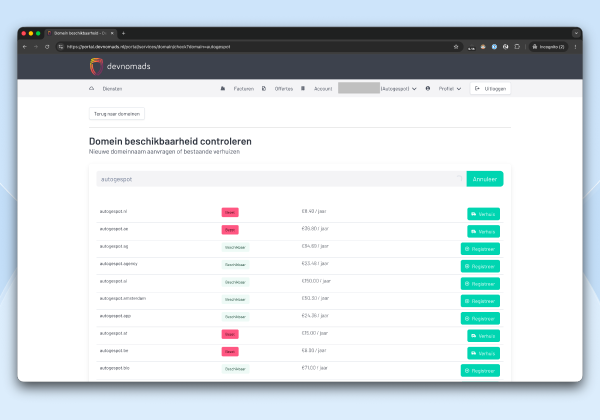
DevNomads integrated Openprovider’s API directly into their own customer control panel. Every registration, transfer, and renewal flows through that single integration – automated, consistent, and managed entirely within their own platform. No manual steps. No separate logins. No reconciliation across systems that don’t talk to each other.
When a renewal is due, it happens automatically. When a customer has a domain question, the answer is already in the portal. When something goes wrong, the answer to “where is this managed?” takes seconds – not a trawl through multiple dashboards. As the portfolio grows, the operational effort per client decreases, rather than compounding the way it does in a fragmented setup.
“The API is great,” says Loek. “We have a simple control panel and a policy that if a customer has to ask us something three times, it needs to be automated. Domains aren’t our core product in terms of revenue, but they are one of the most important products. It’s something we can just offload to Openprovider without having to think about it all too much. We can implement everything in our portal, and if there are issues with a domain name I can just send an email to the support desk and it gets handled properly and quickly. That’s a load off for me.”
With their full domain lifecycle running through a single platform at predictable costs, DevNomads enjoys full visibility over everything.
That said, automation alone only goes so far.
Bulk onboarding without the commercial friction
When a marketing agency joins DevNomads, they don’t bring one or two domains – they bring entire portfolios. Openprovider’s API handles those bulk transfers quickly and reliably, without the process becoming a bottleneck at precisely the moment when first impressions matter most.
There’s also a commercial objection to manage. Customers transferring large portfolios often assume the move will trigger a wave of renewal charges – which can stall the conversation before it moves forward.
Openprovider, however, removes that barrier entirely.
“The fact that when you transfer a domain (to Openprovider) the registration date stays the same – that’s a very big selling point,” says Loek. “If you go to a customer and say ‘I want to transfer 200 of your domain names,’ they usually think that’s 200 times the registration fee all at once. Because that’s not the case, it’s way easier to convince them. It’s business as usual for them.“
For a team that grows its portfolio in sudden bursts, this is a meaningful commercial advantage built directly into how the platform works. And while every TLD comes with its own transfer intricacies, that’s precisely where Openprovider’s support desk earns its stripes.
Expert support that protects margin and client relationships
Not everything in domain management can be automated. Registry disputes, jurisdiction-specific requirements, and compliance mismatches have a habit of appearing at the worst possible moment.
When those situations arise, a lean team needs a partner that takes ownership rather than one that logs a ticket and waits. Openprovider’s 24/7 email support means there’s always someone available to do exactly that.
For example, when a DevNomads customer’s Russian domain transfer stalled over a Chamber of Commerce registration mismatch – requiring back-and-forth with a registry that still operates by fax – Openprovider’s support team stepped in to resolve the issue end to end.
“I was just chatting with the support team, sending information back and forth, and they handled all the communication with the Russian registry,” says Loek. “I was very happy I didn’t have to do that myself.”
Every problem Openprovider solves is time and attention that stays inside DevNomads’ business.
With support handled, the remaining piece of the model is the one that makes everything else commercially sustainable.
Wholesale domain rates that make fair pricing viable at scale
As an Openprovider Member since 2019, DevNomads can register, transfer, and renew domains at wholesale rates.
With thousands of domains under management, that pricing structure compounds: lower cost-per-domain on every renewal, predictable economics across the full lifecycle, and margin headroom that makes fair customer pricing viable rather than a sacrifice.
Controlling that cost base is what makes a transparent pricing model actually deliver. Membership is what makes the arithmetic work – and as the relationship with Openprovider deepens, it opens up more than just domain discounts.
Members can also access infrastructure products like SSL, email hosting, and DMARC at exclusive rates – each one an opportunity to deepen client attachment, improve margins, and grow revenue without adding headcount.
The right domain infrastructure changes everything
For most providers, domain infrastructure doesn’t generate the highest margins – but it enables everything that does.
For DevNomads, managing it well is what allows a small team to serve 250 business clients – mainly managed hosting – handle thousands of domains, and keep growing without compromising the autonomy and transparency that defines them.
To this end, Openprovider isn’t just a registrar for them. Our platform and API are the foundation that makes the whole model work – the automation that removes the admin, the support that handles the unexpected, and the pricing that makes fairness commercially viable.
We’re proud to be part of the infrastructure that gives ambitious businesses like DevNomads the autonomy and freedom to deliver great service on their own terms.
Find out how Openprovider Membership can help you centralize your domain infrastructure, protect your margins, and grow your portfolio without growing your headcount. You can also take the Openprovider platform for a free test drive here – no credit card required.