
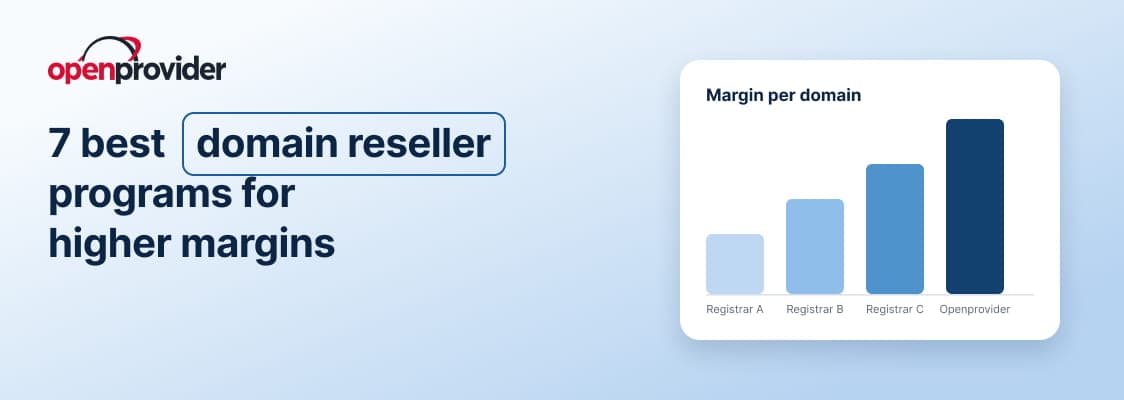
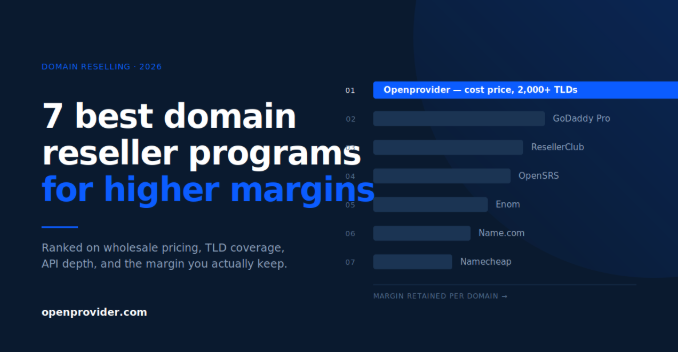
The best domain reseller program for higher profit margins in 2026 is Openprovider Membership. Openprovider Membership offers cost-price access to 2,000+ TLDs with no sudden increases at renewal.The platform itself adds full control over branding, a REST API plus WHMCS integration, and zero upselling to your customers. GoDaddy Pro Reseller offers strong brand recognition for US-based agencies, but its retail-adjacent pricing can’t match Openprovider Membership cost-price margins. OpenSRS: a long-standing option for high-volume resellers, but its XML-based API is heavier to build on than Openprovider’s lighter OpenAPI-spec REST API.
Selling domains is one of the few SaaS-adjacent businesses with near-zero infrastructure cost and recurring revenue. The right reseller platform gives you registry-cost domains, white-label control, and an API that lets one person manage 10,000 domains. The wrong one cuts into your margins with markup pricing.
We compared 7 platforms on pricing, TLD coverage, automation depth, and actual reseller margins. Here’s the full breakdown.
What is a domain reseller program?
A domain reseller program is a partnership in which an ICANN-accredited registrar provides you with wholesale access to register, transfer, manage, and sell domains under your own brand, while they handle the technical infrastructure.
Here’s how the supply chain works: ICANN → Registry → Registrar → Reseller (you) → End customer.
Becoming an ICANN-accredited registrar rarely pays off. It requires a $3,500 non-refundable application fee, a $4,000 annual fee, and proof of at least $70,000 in liquid capital (Source). Plus, you must also cover compliance overhead and legal insurance.
There are two primary reseller models:
- A sub-reseller uses the platform’s storefront.
- An API-integrated reseller builds a custom UI.
How we ranked the best domain reseller programs
We scored each platform on these eight factors:
- Wholesale pricing model (cost-price flat fee vs tiered vs marked-up)
- TLD coverage (more TLDs = more upsell room)
- API quality + WHMCS/Plesk/Blesta integrations (ease of connecting to your existing billing and hosting stack)
- White-label depth (branded panels, branded emails, custom URLs)
- No upselling to your customers (critical – some registrars steal your clients)
- Minimum deposit/signup friction (how fast you can get an account live and how much cash you need to lock up before you can start reselling)
- Support quality (Trustpilot, G2 scores)
- Bundle products available (SSL, DNS, email, Plesk)
Best domain reseller programs in 2026 at a glance (Comparison Table)
| Platform | Best For | Pricing Model | TLDs | White-Label | API | Min. Deposit |
| Openprovider | Agencies, MSPs, hosters | Flat-fee Membership → cost-price | 2,000+ | ✅ Partial | ✅ REST + WHMCS | $4.99 Basic S) |
| GoDaddy Pro Reseller | US agencies, brand trust | Tiered wholesale | 500+ | ✅ Partial | ✅ | Annual plan fee |
| ResellerClub | All-in-one bundlers | Volume-tiered | 500+ | ✅ Full | ✅ | $25 |
| OpenSRS | Developers, custom builds | Tiered wholesale | 730+ | ✅ Full | ✅ Best-in-class | None |
| Enom | Legacy resellers | Tiered | 550+ | ✅ | ✅ | None |
| Name.com Reseller | AI-first developers | Wholesale | 600+ | ✅ Partial | ✅ MCP server | None |
| Namecheap Reseller | Beginners | Markup-based | 437+ | Limited | ✅ Basic | $50 |
1. Openprovider: Best AI-native domain reseller program overall
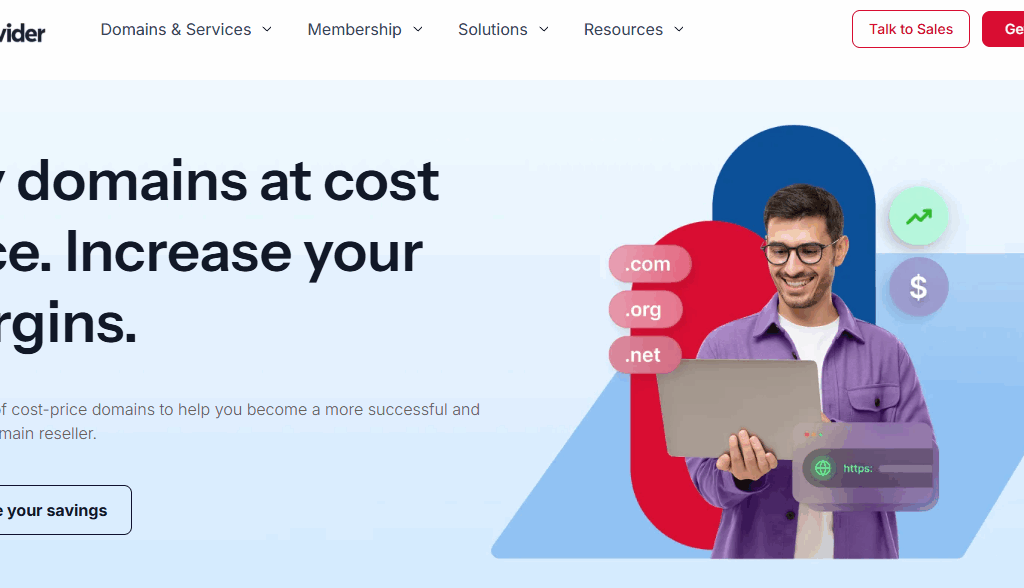
Openprovider is an ICANN-accredited and ISO 27001-certified registrar built exclusively for resellers. Openprovider’s star feature is its flexible flat-fee Membership model. Members gain access to 2,000+ TLDs at cost price, the largest TLD catalog of any reseller-focused platform. More TLDs mean greater customer choice and higher upsell potential.
If you are a reseller managing domains at scale, Openprovider’s robust API and automation features help you manage your entire portfolio on one platform. Our MCP server lets AI assistants securely manage domains, DNS, and SSL on your behalf. The best part? You handle those tasks using plain-language requests. This makes Openprovider a strong choice for hosting providers and growing reseller businesses.
Additionally, it’s white-label-ready for full control over branding via a backend integration.
Pros
- Cheapest option at scale for portfolios of 50+ domains
- Transparent, predictable pricing with no hidden fees or surprise renewal costs
- Strong European ccTLD coverage (.de, .fr, .nl, .eu)
- No competing retail brand chasing your customers
- Full automation stack: REST API, WHMCS module, Plesk, Blesta integrations, bulk operations
- MCP server lets AI assistants check availability, register domains, edit DNS zones, and order certificates using natural language
Cons
- No drop-catch or backorder service
- Membership fee only pays off past a certain volume, so run the math first
Choose if: You want flat-fee, cost-price domains and a REST API plus MCP server built to handle high-volume domain operations for resellers, hosts, agencies, and SaaS providers.
2. GoDaddy Pro Reseller: Best for US-based agencies

GoDaddy’s reseller program is backed by the world’s largest registrar and a globally recognized brand, with its strongest presence in the U.S. GoDaddy has a polished UX and an all-in-one experience that bundles domains, hosting, a site builder, and email services. But GoDaddy’s high renewal costs eat into your profit margins over time.
Pros
- Trusted name that reassures end customers
- Clean, modern UX
- Bundled services across domains, hosting, and email
- Solid uptime and support infrastructure
Cons
- Higher wholesale pricing than Openprovider or OpenSRS
- Occasional aggressive upsells directed at your customers
Choose if: Your customers value the GoDaddy brand, and you don’t mind tighter margins.
3. ResellerClub: Best all-in-one bundle reseller

ResellerClub is a long-running domain, hosting, SSL, and email reseller. ResellerClub is built around bundling, so you can sell a customer a domain, hosting plan, and security add-on in a single checkout. Indian and emerging-market agencies make up much of the ResellerClub’s customer base.
Pros
- 500+ TLDs
- Bundleable hosting services
- SSL, SiteLock, and CodeGuard
- Full white-label storefront with custom branding
Cons
- Volume-tiered pricing means small resellers pay more
- The storefront feels dated compared to newer platforms
Choose if: You want to sell domains, hosting, and security as one package.
4. OpenSRS: Best API for developers building custom platforms
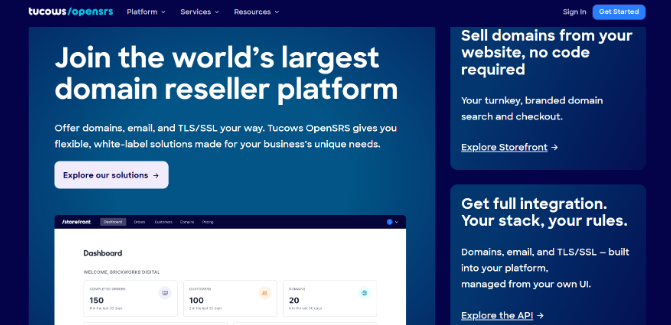
OpenSRS, owned by Tucows, is a wholesale registrar trusted by major hosters, including Shopify and Hover. OpenSRS ‘reputation rests on infrastructure reliability rather than a polished front end, which makes it a favorite among teams shipping their own reseller product.
Pros
- Industry-leading API with deep, well-maintained documentation
- 730+ TLDs
- White-label DNS and email options
- Strong uptime track record at scale
Cons
- Less polished dashboard for non-developers
- Pricing is tier-based rather than flat-fee
Choose if: You’re building a custom domain-selling product (SaaS, web platform, app) and need a reliable API.
5. Enom: Best for legacy reseller operations
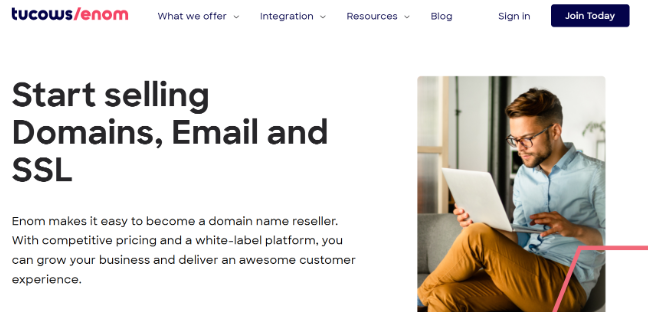
Enom, also Tucows-owned, is a mature reseller platform with a long track record dating back to the early 2000s. Many legacy web hosting companies still run on Enom, which keeps its infrastructure battle-tested even if its pricing feels less modern.
Pros
- Established program with a long operating history
- White-label tools
- Broad TLD catalog
- Familiar to hosters who’ve used it for years
Cons
- Pricing tiers can be opaque
- Less competitive than flat-fee models like Openprovider.
Choose if: You want a legacy platform with a long track record.
6. Name.com Reseller: Best for AI-native developers
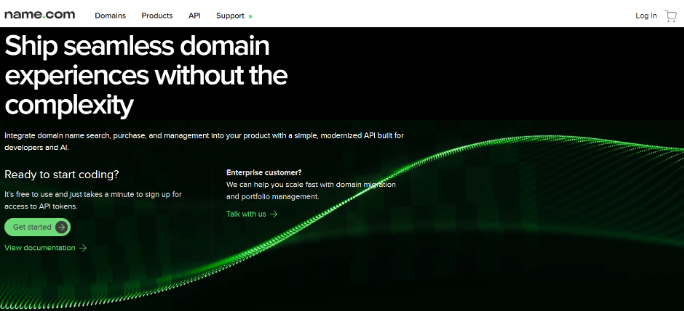
Name.com built its reseller API for modern developer workflows, including an MCP server for AI agents. While Name.com is a smaller platform than most on this list, it stands out for shipping AI-native tools ahead of larger competitors.
Pros
- Clean, OpenAPI-documented REST API
- Fast response times
- A rare MCP server for the LLM tool use
- Straightforward developer onboarding
Cons
- Smaller TLD catalog than the bigger players
- Less established reseller community
Choose if: You’re building AI-powered tooling that manages domains programmatically.
7. Namecheap Reseller: Best for absolute beginners
Namecheap offers an entry-level program with a low sign-up barrier. It’s aimed squarely at people testing the reseller model for the first time. However, Namecheap won’t scale efficiently beyond a small portfolio due to limited bulk-automation features for larger portfolios.
Pros
- Affordable $50 deposit
- Familiar interface most customers already trust
- Free WHOIS privacy included
- Simple, guided signup flow for quick start
Cons
- Markup-based pricing rather than true wholesale
- Hosting and VPN upsells are pushed to your customers
Choose if: You’re testing the waters with under 50 domains and want a low-friction start.
How domain reseller programs make money (the economics)
As a domain reseller you make money through:
- Wholesale vs retail spread: a .com costs $10.26 wholesale today, rising to $10.97 on November 1, 2026, and retails for ~$11 to $20. (Source)
- The loss-leader play: sell domains near cost, profit on hosting/SSL/email
- Recurring revenue math (est): 1,000 domains × -$5 margin × ~75% renewal = $3,750/year passive
- Ecosystem lock-in: once a customer registers with you, they rarely move hosting, email, or SSL elsewhere
- Bundle margins: products like SSL, Premium DNS, SpamExperts and business email, typically have 40–70% margins, vs ~15% on domains alone
Your profits scale with portfolio size:
| Portfolio Size | Avg Margin/Domain | Bundle Attach (30%) | Annual Recurring Revenue |
| 100 domains | $5 | $15 SSL/email | $950 |
| 1,000 domains | $5 | $15 SSL/email | $9,500 |
| 10,000 domains | $5 | $15 SSL/email | $95,000 |
Note that these are estimates. The exact dollar amount you can earn from selling domains depends on your pricing strategy, upselling, and churn rate.
Final Verdict: Which domain reseller program should you pick?
The best domain reseller program depends on your target market, business stage, or goals.
- Agency or MSP managing 50+ domains → Openprovider
- US-focused, brand trust matters → GoDaddy Pro Reseller
- Bundling domains, hosting, and SSL → ResellerClub
- Building a custom platform with an API → OpenSRS or Name.com
- Absolute beginner under 50 domains → Namecheap Reseller
For most resellers, the math favors cost-price pricing.
Openprovider’s free Membership Plan lets you test the platform with zero risk. Start there, then upgrade once your portfolio justifies it.
Frequently Asked Questions about domain reseller programs
What is the best domain reseller program in 2026?
Openprovider, offering cost-price access to 2,000+ TLDs through its flat-fee Membership, full control over branding, and a strict no-upsell policy. GoDaddy Pro Reseller is the strongest alternative for US-focused agencies.
How much does a domain reseller program cost to join?
Most are free. Openprovider, OpenSRS, Enom, and Name.com don’t charge any signup fees. Namecheap requires a $50 deposit, while ResellerClub requires a $99 deposit. Paid Openprovider Memberships unlock cost-price pricing from only $4.99/year.
How much can you make reselling domains?
Realistic estimates range from $375 to $950 a year for a 100-domain side hustle, and $37,500 to $95,000 a year for a 10,000+ domain full-time reseller. The low end reflects domain margin alone at a 75% renewal rate, and the high end adds bundle attach revenue from products like SSL and email.
What is white-label domain reselling?
Selling domains under your own brand, with no visible link to the underlying registrar. Customers see only your logo, panel, and support emails, with renewal reminders sent from your own domain.
Can I resell domains and hosting together?
Yes, and most serious resellers do. Domains anchor the customer relationship at a low margin. Hosting, SSL certificates, and email carry the higher margins. Openprovider pairs domains with adjacent products like SSL and email, while ResellerClub bundles domains directly with hosting plans.
Which domain reseller program has the most TLDs?
Openprovider leads with 2,000+ supported TLDs, well ahead of GoDaddy, Namecheap, and OpenSRS, which offer 437–730+.