

In this article:
- Proprietary, original registry rankings data that Openprovider provides to registries themselves
- Key TLDs managed and market presence
- The registry cost-price business model that helps domain reselling businesses increase profits
Choosing a domain registrar is a commercial decision, not just a technical one.
Web hosts, agencies, and managed service providers, along with domain resellers need predictable pricing, reliable automation, strong country-code domain coverage, and a platform that can support growth without adding operational overhead.
Openprovider stands out because it combines all four in a reseller-first model.
Why do domain resellers across major European markets trust Openprovider?
Openprovider helps large domain portfolio holders across multiple gTLDs and country-code extensions manage their domains.
With 21+ years of experience in the industry, they provide registry rankings information to the major registries of the world.
If a registrar business usually claims to have competitive pricing, strong support, reliable systems, etc., registry rankings offer a more objective signal.
A registry ranking is a performance indicator based on actual domains under management for a live extension. That makes rankings especially useful for resellers comparing operational scale and market presence.
Across Europe, Openprovider consistently appears among the leading registrars in multiple ccTLD markets: strong positions across several ccTLDs indicate broad operational capability, local market relevance, and reseller trust.
Registry rankings show verified market presence across multiple TLDs
Registry rankings are lists published by domain registries that show how many domains each registrar manages under a specific TLD.
These rankings reflect real customer portfolios, not marketing claims: they show verified market presence because they are published by the registries themselves and reflect active domain portfolios or recent registration activity.
For domain resellers, every domain in a registry ranking represents a customer asset that must be registered, renewed, transferred, and supported correctly.
Top registry ranking by domain volume – quick table by Openprovider
| SIDN | .nl | #2 | 682,616 |
| DNS Belgium | .be | #3 | 186,455 |
| NIC ES | .es | #4 | 171,631 |
| EURid | .eu | #6 | 122,395 |
| AFNIC | .fr | #9 | 103,318 |
Source: proprietary, verified data from Openprovider, serving top leading registries with insights about TLDs
If you want to access full registry ranking data, TLD statistics, and other information about domains, contact us.
These numbers show that Openprovider manages substantial portfolios across some of Europe’s most commercially important domain markets.
Top registry by most active – Partial table by Openprovider
| Registry | TLD | Position | Domains / activity |
| IIS | .se | #4 most active | 3,310 new registrations in the last 3 months |
| IIS | .nu | #7 most active | 409 new registrations in the last 3 months |
The Swedish and .nu entries measure recent registration activity rather than total domains under management.
Recent registration activity is the number of new domains created during a defined timeframe.
In this case, the timeframe is the last three months as of March 2026.
Domain operations for key TLDs
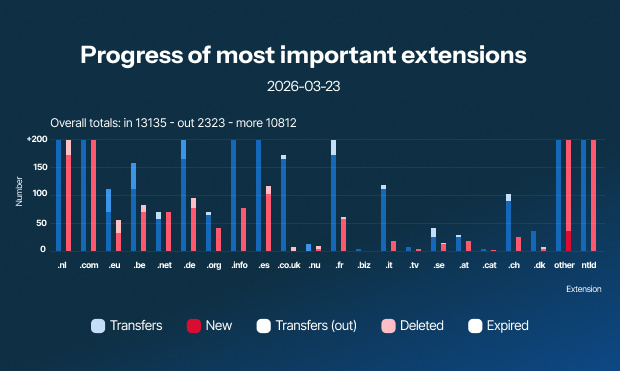
The table also shows that Openprovider is not concentrated in only one region.
The presence spans western, southern, northern, and pan-European extensions, which is important for resellers serving customers across multiple countries.
This shows that Openprovider is not only maintaining legacy portfolios but also actively winning new business in those markets.
Registry rankings reflect operational trust, not just visibility
Registry rankings reflect operational trust because every ranked domain represents a business decision to place a customer asset on a specific platform.
Domains are recurring, business-infrastructure assets. They must be renewed, transferred, updated, secured, and supported throughout their lifecycle.
When a registrar appears consistently across multiple European registry rankings, the signal is stronger than a single market result: it suggests that resellers in different countries and business models have made the same platform choice for live customer portfolios.
For Openprovider, that supports the broader claim that the company has become one of Europe’s largest reseller-focused registrars.
Openprovider’s presence in other key markets
Openprovider also has a strong presence in additional key markets because not every registry publishes the same type of public ranking data.
Note: the absence of a public ranking does not mean the absence of a meaningful portfolio, but that the registry does not publish equivalent registrar statistics in the same format.
Openprovider also manages significant portfolios in several large and strategically important ccTLD markets, including .uk, .ca, .de, .it, .pl, and .fi.
These are mature domain markets with established competition, local policy requirements, and customers who expect stable domain management processes.
Note: a mature domain market is a market in which domain registrations are already well established, competition is strong, and buyers expect professional service quality.
Mature markets are important because operational mistakes become more expensive when customers rely on domains for active business use.
Strong performance in these markets points to consistent infrastructure, reliable processes, and local domain expertise.
Deep ccTLD expertise reduces friction in complex local markets
Deep ccTLD expertise reduces friction in complex local markets because country-code domains often follow rules that do not apply to generic extensions.
Country-code domains can involve local presence requirements, registry-specific procedures, documentation checks, naming restrictions, or special transfer flows.
Note: ccTLD expertise is the operational knowledge required to register, transfer, and maintain country-code domains in line with local registry requirements.
A local presence requirement is a rule that requires the registrant to have a legal, administrative, or service presence in a specific country.
These requirements vary by extension and can slow down operations when a provider lacks direct experience.
So, a domain supplier with deep ccTLD knowledge can process exceptions faster, explain local rules more clearly, and help prevent failed registrations or delayed transfers.
Openprovider has built expertise with ccTLD operations for more than two decades.
The registry cost-price business model that helps domain resellers increase profits
Openprovider’s ranking position matters because the business is focused on wholesale rather than retail end-user sales.
A wholesale registrar is a registrar that serves resellers, hosting companies, agencies, SaaS providers, and domain professionals who manage domains on behalf of their own customers.
Most registry rankings mix all registrar types in one list.
That means a reseller-focused registrar is often compared directly with large retail hosting brands that sell domains mainly to end users. But the business models are not the same.
Retail-focused providers optimize for direct customer acquisition, while wholesale-focused providers optimize for reseller margins, automation, and portfolio management.
The wholesale model of Openprovider is called registry cost-price: it offers core domain operations like registration, transfer and renewals at the same price of purchase from the registry with no markup, whenever possible.
So, when a wholesale registrar reaches top positions in registry rankings that include both retail and wholesale players, the result reflects strong reseller adoption rather than direct-to-consumer volume.
For a reseller evaluating providers, that distinction is commercially relevant: Openprovider serves businesses that resell domains as part of their own offer.
That means the platform, pricing logic, and operational priorities are aligned with portfolio management rather than consumer checkout optimization.
Discover more about cost price domains.
Resellers move portfolios when pricing becomes more transparent and sustainable
Resellers move portfolios when pricing becomes more transparent and sustainable because recurring domain revenue depends on predictable costs.
Transparent pricing is a pricing model in which registration, renewal, and transfer costs are clearly structured and not hidden behind temporary promotions, unclear tiering, or inconsistent discounts.
Large domain portfolios rarely move without a clear reason.
Note: a portfolio transfer is the process by which a reseller moves multiple domains from one registrar to another.
Portfolio transfers usually happen when the current supplier creates pricing pressure, operational inefficiency, or limitations around automation and TLD coverage.
Openprovider’s Membership model is designed to solve margin pressure directly.
Members receive domains at cost price.
Cost price is the base purchase price at the domain registry, without an added markup from the platform provider.
For domain resellers, this is important because margin planning becomes easier when the underlying domain cost is more predictable over time.
Domain portfolios create recurring renewal exposure every year: a reseller with unstable supplier pricing can lose margin even when customer retention stays high. Transparent domain pricing reduces that risk and helps support long-term customer contracts.
For readers who want to explore the commercial model in more detail, the most relevant destination is Openprovider Membership plans.
Automation is essential for profitable domain portfolio management
Domain automation is the process by which recurring tasks such as registrations, renewals, transfers, DNS changes, and lifecycle updates are handled through software instead of repeated manual action.
It is essential for profitable domain portfolio management because manual domain operations create avoidable cost, delay, and error risk.
Domain resellers do not only sell domains, but also manage operational workflows around those domains, including:
- TLD order handling
- DNS configuration changes
- Domain renewal management
- Domain transfer processing
- Customer communication and support
As portfolio size grows, manual handling becomes harder to scale without increasing support load or staffing costs.
Openprovider provides the tools resellers need to automate manual workflows efficiently.
The platform includes a powerful API, integrations with tools such as WHMCS, automated provisioning, lifecycle management, and the ability to manage DNS and SSL products from the same environment.
That combination matters because a fragmented tool stack creates more support tickets, more reconciliation work, and a higher risk of configuration mistakes.
Centralized domain automation helps to reduce operational friction while improving response speed for end customers.
For teams that want a user-friendly domain management interface alongside automation, the most relevant tool is the Reseller Control Panel.
The bottom line: resellers choose Openprovider for scale, control, and efficiency
The bottom line is that resellers choose Openprovider for scale, control, and efficiency because those are the factors that determine whether a domain business can grow profitably.
Scale is the ability to support large portfolios and multiple TLDs.
Control is the ability to manage pricing, workflows, and customer assets effectively.
Efficiency is the ability to do that with less operational overhead.
Across Europe’s most important country-code domains, Openprovider consistently ranks among the leading registrars and maintains strong portfolios in additional geo markets.
Because Openprovider is focused on wholesale rather than retail, those results are especially relevant for hosting companies, SaaS platforms, agencies, and domain professionals.
For businesses that resell domains, the value proposition is clear: transparent pricing through Membership, automation through API and platform tooling, and strong ccTLD expertise across multiple local markets.
That combination is why so many domain resellers continue to choose Openprovider for long-term portfolio management.
To get started directly, the clearest conversion point is Create a free account.
Frequently Asked Questions
Why do registry rankings matter when choosing a domain registrar?
Registry rankings matter because they reflect real domains under management or real registration activity within a specific extension. A registry ranking is more useful than a generic marketing claim because it is tied to live operational volume. For a reseller, that matters because a large portfolio usually indicates proven infrastructure, repeatable processes, and the ability to support customers reliably across registration, renewal, and transfer workflows.
Why is wholesale focus important for domain resellers?
Wholesale focus is important because resellers need a supplier that is built around portfolio management rather than direct-to-consumer sales. A wholesale registrar is designed to support businesses that sell domains to their own customers. That usually means better alignment around automation, pricing predictability, TLD coverage, and operational efficiency. For resellers, this alignment is more valuable than consumer promotions or retail-focused checkout experiences.
What makes Openprovider different from a retail-focused registrar?
Openprovider differs from a retail-focused registrar because the platform is designed primarily for resellers, hosters, agencies, SaaS providers, and domain professionals. A retail-focused registrar usually optimizes for end-user conversion and direct sales. Openprovider instead emphasizes margin control, cost-price domain access through Membership, automation, and ccTLD expertise. That makes the platform more relevant for businesses managing domains as part of a recurring service model.
Why does ccTLD expertise matter for agencies and hosting companies?
ccTLD expertise matters because local domain extensions often come with registry-specific requirements that can slow down registration or transfer processes. Those requirements may include local presence rules, documentation checks, or special procedures. An agency or hosting company that manages customer domains across multiple countries benefits from a supplier that understands those details well. Better ccTLD handling reduces delays, lowers support effort, and improves the customer experience.
When do resellers usually transfer domain portfolios to a new provider?
Resellers usually transfer domain portfolios when three pressures build at the same time: pricing becomes difficult to predict, manual processes consume too much time, and the current provider cannot support the desired mix of extensions or integrations. A portfolio transfer is rarely driven by one small issue. It usually happens when commercial and operational inefficiencies start affecting margins, customer service quality, or the ability to scale the reseller business.
Is Openprovider only relevant for large domain resellers?
Openprovider is not only relevant for large domain resellers. Large resellers benefit from automation, API access, and scale, but smaller hosting companies, agencies, and IT service providers can also benefit from better pricing transparency and centralized domain management. The business value depends less on company size and more on whether domains are part of an ongoing client service. Any business managing customer domains repeatedly can benefit from a reseller-focused platform.