
The internet has entered a new era. For more than two decades, websites competed for visibility through traditional search engines, optimizing content to earn a place on a page of links.
Today, that model is rapidly evolving. AI-powered search experiences from tools like ChatGPT, Google AI Overviews, Gemini, and Claude are changing how people discover information, products, and businesses. Instead of browsing dozens of search results, users are increasingly asking a question and trusting a single synthesized answer.
This shift has significant implications for businesses. Success is no longer measured only by where you rank in search results, but by whether your brand is recognized, understood, and selected by AI systems as a trustworthy source. Content quality, technical SEO, structured data, and brand authority all remain essential, but they are now part of a much broader picture.
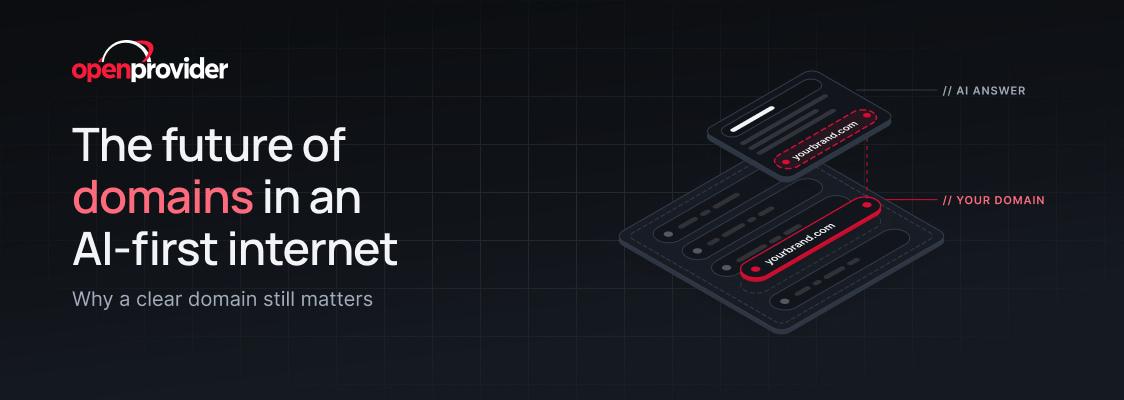
Your domain name is part of that picture. It is often the first signal that both people and AI systems encounter when evaluating your website. A clear, descriptive domain can reinforce what your business does, strengthen brand recognition, and provide another piece of context that supports your site’s overall relevance and credibility.
As AI becomes the primary gateway to information, domains are evolving from simple web addresses into important digital identity assets.
In this article, we look at what’s changing and what it means for the domain behind your website.
Zero-click is the new normal
The numbers are growing quickly, so ‘AI search’ is now a real part of strategic business planning. One widely cited study estimates that AI platforms handle about 45 billion sessions per month worldwide, which is more than half the volume of traditional search engines. In the US, AI platforms generate around 5.4 billion monthly sessions, about a third of total US search volume, and that number grew by 300% year over year. The trend is clear: there are fewer clicks, more conversations, and more discovery happening inside AI chat windows instead of on search results pages.
This is something business owners should pay close attention to. Zero-click searches reached record highs in 2025, with 58.5% of US searches and nearly 60% of EU searches ending without a single click to an outside website. When Google’s AI Mode is used, that number goes even higher, with up to 93% of AI Mode sessions ending without any clicks.
This is a major change. In the past, ranking well almost always meant you would get visitors. Now, being cited or summarized accurately by an AI system is just as important as ranking, and sometimes it matters even more. To improve the chances of your content being cited or correctly summarized by AI platforms, focus on making your website content clear and straightforward, using simple language that directly answers common questions in your field. Marketers can also use structured data, update meta descriptions to be concise and accurate, and regularly review how their brand and content appear inside AI chat summaries.
Setting up files like llms.txt further signals to AI systems how your content should be referenced. This is where domains start to play a subtle but important role.
Where domains fit into an AI-first web
AI systems do not experience a website the same way people do. They build answers from pieces of text, so every clear and consistent signal helps. A domain name that clearly shows what a business does is one of the simplest signals available. There is no need for crawling to understand it.
This is also why tools like llms.txt are starting to appear. It is a plain-text file that gives AI systems a description of a site and guidance on which content can be cited or referenced. It sits alongside your robots.txt and sitemap files.
Getting started is simple: open a text editor, create a new file named llms.txt, and write a short description of your website, along with any specific instructions for AI systems on which content is approved for citation or reference.
Upload this file to the root directory of your website, just like you would with robots.txt. Adoption is still in the early stages, with current estimates showing usage between 5% and 15% among tech and documentation-heavy sites. Still, it is a good example of how the web is quietly adding new infrastructure so AI systems can understand sites more quickly.
A domain follows the same logic. It is not a magic tool for ranking, but a clear and descriptive domain makes it easier for both people and AI models to understand what a site is about quickly.
What this means for your domain strategy
This does not mean you need to chase trendy extensions or completely change your brand right away. Instead, treat your domain with the same focus on clarity that is already changing content and technical SEO.
Here are a few practical things to consider:
- Favour domains that describe the business clearly, without needing extra context. TLDs like .law, or .health are great examples of industry-specific domains; alternatively you can utilize domains like .biz or .club for generalized brands.
- Keep domain naming and content messaging consistent across your whole portfolio.
- Think of domain choice as an important early step for AI visibility, not something to add on at the end.
If you manage more than a few domains, this is where a registrar designed for portfolio management becomes valuable. Openprovider helps you review your domains for clarity and consistency, register new domains that support your brand story, and keep everything organized as your AI presence grows.
Remember that managing your domains is only one part of preparing for an AI-first internet. The bigger opportunity is being intentional about every signal your digital presence sends. Your domain, website content, business information, and brand identity all work together to help both users and AI systems understand who you are, what you offer, and when you should be recommended.
AI-first search is still changing, and no one has it completely figured out yet, not even the AI platforms. But one thing is clear: clarity wins. A domain that clearly states what your business does, along with content built the same way, gives you an advantage in a search world where people often do not click at all.