

In hosting and domains, churn often looks like something that just happens in business. A renewal doesn’t go through, a client “moves providers,” a credit card expires, a ticket thread drags on too long. But churn doesn’t “just happen.”
If you want to reduce churn in hosting business lines, you have to treat churn like a “leak” that usually starts long before a cancellation email hits your inbox.
Here’s the uncomfortable truth: while the economy of the web hosting industry grows stronger, operational challenges and churn grow too. And they might as well be mainly self-inflicted.
This article breaks down what churn really means in hosting and domains, and how to fix the root causes without getting caught in the race to the bottom on price.
We’ll use proprietary and industry data to deep dive into the root causes of churn and to demonstrate how bundling strategies can mitigate it.
Churn in the hosting business is a margin and trust problem
In hosting and domain businesses, churn is the slow bleed of customers, revenue, and account activity over time, usually triggered by a mix of price pressure and operational friction.
Smaller and mid-sized providers found themselves competing with ultra-low entry pricing, and still carry heavy support and marketing costs.
For bigger companies, the market has normalized aggressive loss-leader pricing, while customers now expect deep discounts up front, then shop around again at renewal.
In fact, if we focus on the entry price of major players in 2020 vs 2025, we observe:
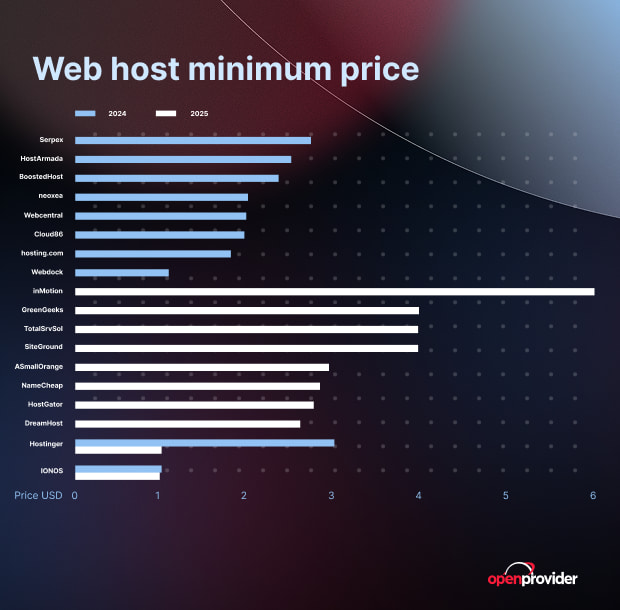
Average price comparison
- 2020 mean: $3.09 /month
- 2025 mean: $2.03 /month
- Overall change: -34.3% decline
Absolute cheapest options
- 2020: $0.99 /month (1&1 IONOS and Hostinger)
- 2025: $1.00 /month (IONOS)
- Change: +1.0% (essentially flat)
Study from data combined across multiple sources, including Openprovider’s proprietary platform, Hostinger 1 , HostAdvice 2 and WPbeginner 3.
But, as we’ll see after in this article, there are proven strategies – like bundling hosting infrastructure with full domain management – that make it harder for customers to leave.
Operational friction is a churn multiplier in hosting and domains
Our research and customer interactions reveal consistent pressure points for hosting providers..
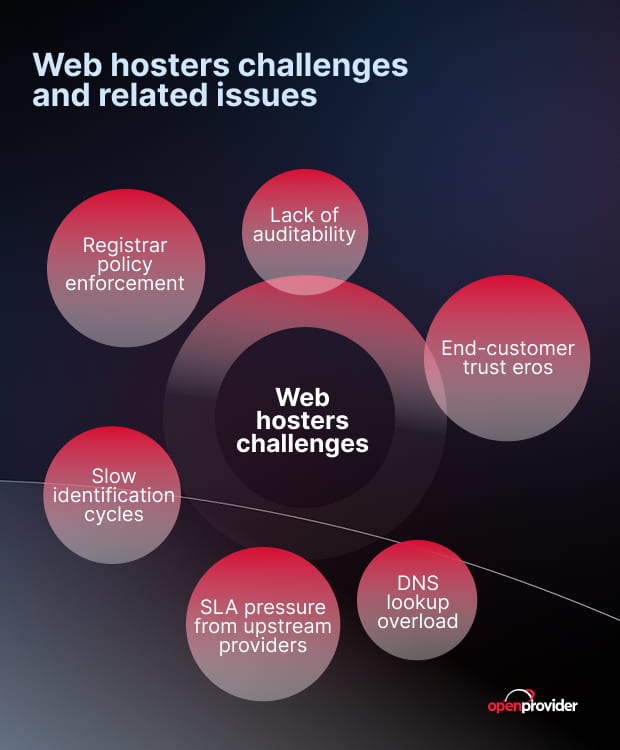
Technical support tickets and downtime from the hosting side, as well as fragmented registrar’s and DNS’ ecosystems from the domain management side drive high operational load.
Behind every hosting package, there’s a tangled web of interfaces, billing layers, and disconnected vendors.
For instance, the company buys domains from one provider, manages DNS through another, issues SSLs manually and independently, and adds email services ad hoc.
Then, every sub-area becomes a potential support ticket impossible to close in one step.
Our interviews, surveys, and platform observations across hundreds of providers have pin-pointed the struggles with margins, platform fragmentation, feature lags and abuse management that are tearing the industry apart.
During the interviews with partners like CCC Hosting, Supreme Hosting, and NIJM, one theme stood out clearly: value delivery must be fast, complete, and visible.
This can be reduced to a simple concept. Arjan Nijmeijer, owner of NIJM framed it well:
“I wanted to combine good service and quality servers at an affordable price, while also making sure my clients always had access to the latest technology”.
Reducing churn, then, means reducing the number of touchpoints required to keep an account healthy: fewer manual checks, fewer renewal surprises, fewer back-and-forth tickets, and a cleaner self-serve experience for domain and hosting management.
Domain abuse is an operational issue that contributes to churn
When the 2023 Global DNS Threat Report issued by IDC was reporting an average cost of about $1.1M for DNS attacks, AI has since raised the risks and the stakes.
For web hosting providers, domain abuse is no longer a registrar-only problem.
It’s an operational and reputational issue that lands on support teams and brand reputation.
When a phishing site or malware domain triggers a takedown report, hosting providers are often the first line of defense, whether they manage the domain in-house or not.
And when domain portfolios are spread across multiple registrars, with siloed DNS platforms and disconnected abuse reporting channels, the cost of mitigation rises fast.
In Openprovider’s 21+ years of experience, we have investigated millions of abuse cases with AI-driven monitoring and machine learning-based detection, helping hosting providers mitigate DNS abuse and protect the integrity of their online infrastructure.
In fact, to improve our security-based processes we collaborate with leading threat detectors, like Netcraft.
Marianna Siouti (Lead Product Manager for Domains & DNS at Openprovider), breaks down the entry points of our domain abuse management cycle:
“We offer forms and designated points of contact to allow law enforcement, cybersecurity organizations, and concerned individuals to report abuse. These forms guide users in providing all the necessary information for a thorough investigation.
In addition, we’ve implemented various account validations during sign-up and applied payment review rules to flag suspicious transactions. Payments are assigned risk scores based on industry benchmarks, helping us catch potential abuse early on. We’ve also put in place specific registration and contact validation systems to block fraudulent registrations before they become an issue.”
The fix is not only faster takedowns, but a disciplined abuse workflow: clear monitoring, rapid triage, consistent enforcement, and transparent communication that reassures legitimate customers you are acting fast to protect the network.
Proven strategies to reduce churn by bundling hosting, domains, and ancillaries
Churn happens also when customers view hosting services as a replaceable commodity.
A hosting provider is easy to compare, easy to swap, and easy to cancel when budgets tighten or a promo deal appears elsewhere.
But when it offers a complete digital infrastructure partner that includes domains and essential add-ons that customers actively rely on, switching providers becomes both riskier and more time-consuming.
The data behind customer retention through domain service adoption
Proprietary data observed across about 1,155 domain reseller accounts in Openprovider’s customer base showed the following:
- Hosting providers managing more than 1000 active domains show markedly higher adoption of bundled services (DNS, SSL, email)
- Those above 2,000 domains almost universally engage with Membership tiers that unlock cost-based pricing and volume-driven discounts
- Providers exceeding 5,000 domains typically leverage Memberships plus API integrations and automated provisioning tools, making bundling a core part of their infrastructure strategy
And, it’s not just about how many domains a provider manages, it’s also about how they operate. To aim to faster bundling ROI, we look at:
- API or WHMCS integration capabilities
- Defined customer onboarding workflows Focus on ARPU growth and client retention KPIs
- Existing support challenges tied to product sprawl
Bundle high-retention add-ons to reduce churn in hosting business
The best ancillaries are the ones that customers feel immediately when they are missing. These tend to fall into a few categories:
- Security and trust add-ons: SSL certificates, basic malware monitoring, and security posture features are sticky because they are tied to business continuity and credibility.
- Business email and productivity: business emails are deeply embedded in workflows. Once customers use your mailbox or email bundle, it becomes a high-friction migration to switch.
- Management features: backups, staging, or simplified DNS templates for common stacks.
Thus, bundles shift the retention conversation away from “Is this cheap?” toward “Is this complete?”
And customers should not experience domains as “a different system,” SSL as “a separate checkout,” and email as “another vendor.”
The more unified the experience, the more the bundle behaves like a single product, and the harder it is for churn to take hold.
Conclusions: activating a new digital infrastructure
Bundling an infrastructure is one of the most durable ways to reduce churn because it turns hosting from a commodity into an ecosystem customers depend on.
By addressing churn-related challenges on specific use cases for our clients, we aim to help the entire web hosting industry grow past them.
To help your web hosting business consolidate domain operations and build stickier packages you can start centralize domain management with a free account then layer in the products your customers actually need long-term