
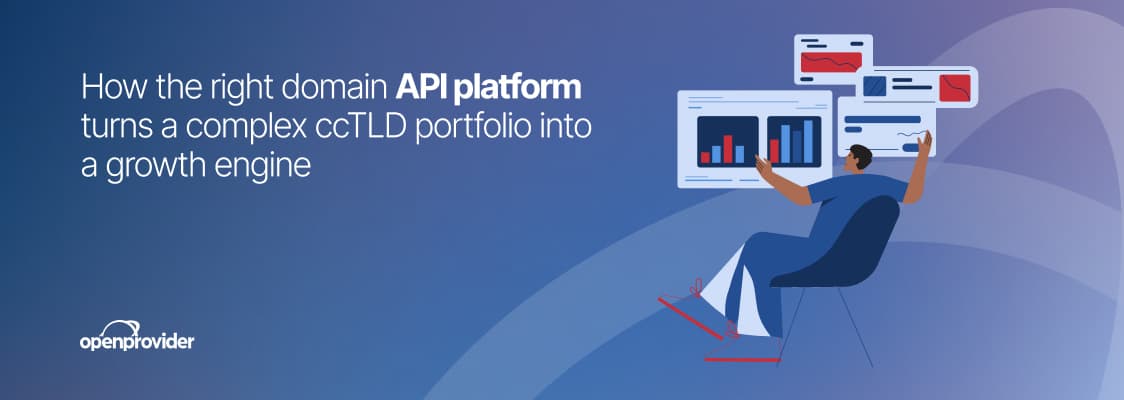
Businesses managing domains across many countries deal with a level of complexity a single-market reseller never sees.
Every ccTLD comes with its own registration rules, renewal windows, and registrant requirements: the go-to solution for successful companies is a domain API platform that works as an infrastructure to help with core operations across multiple markets.
In this blog, we look at how three Openprovider customers – mijn.host, Webador, and DevNomads – handle this, and what becomes possible once the domain admin work is off their plate.
Domain automation absorbs the complexity that comes with every new market
mijn.host, a Dutch hosting platform, runs its entire domain lifecycle through Openprovider’s API. Founder Marijn Vlug puts automation at the center of how the business manages a growing, multi-market portfolio.
“Automation is everything for us,” he says. “Through Openprovider’s API, registrations, transfers, renewals and DNS management run fully automated within our own platform. That means we can manage a growing domain portfolio without growing our operational overhead, and offer our customers a wide range of TLDs at competitive prices. It’s the technical foundation that lets us scale.”
Every registration, transfer, renewal, and DNS update runs inside mijn.host’s own platform, regardless of which country’s TLD is involved. The team doesn’t need to learn a new process every time a client asks for a domain in a market they haven’t served before.
DevNomads, a Dutch infrastructure provider managing thousands of domains across 250 business clients, built the same principle into their own control panel. “The API is great,” says co-owner Loek Geleijn. “We have a simple control panel and a policy that if a customer has to ask us something three times, it needs to be automated. Domains aren’t our core product in terms of revenue, but they are one of the most important products. It’s something we can just offload to Openprovider without having to think about it all too much.”
Both businesses treat the API as the layer that handles ccTLD complexity so their teams don’t have to. That only works, though, if the platform behind the API actually covers the markets a business needs.
One domain API that reaches every market a European business serves
A business with clients across several countries needs a domain partner that covers all of them, not most of them. Missing coverage in even one market means a separate vendor, a separate integration, and a gap in the automation that was supposed to remove that kind of work.
Openprovider gives resellers direct access to more than 2,000 TLDs, including the country-code domains that make up the bulk of a cross-border European portfolio. When a client in a new market needs a domain, it’s already available through the same API and the same account a business uses everywhere else.
For DevNomads, that reach matters most when clients bring existing portfolios across. “The fact that when you transfer a domain, the registration date stays the same – that’s a very big selling point,” says Loek. “If you go to a customer and say ‘I want to transfer 200 of your domain names,’ they usually think that’s 200 times the registration fee all at once. Because that’s not the case, it’s way easier to convince them. It’s business as usual for them.”
That single detail turns a large, multi-country transfer from a hard sell into a straightforward conversation. Once a business can bring any ccTLD portfolio onto one platform, the next question is whether that platform holds up as the portfolio keeps growing.
Reliability keeps a growing ccTLD portfolio from becoming a support burden
Webador, a website builder serving customers across Europe, points to reliability as the reason the partnership works at scale.
“Reliability is huge for us, and that’s what we get with Openprovider,” says Webador CFO Pim Kerckhaert. “We get a platform that works. With Openprovider Membership we have full control over our costs – we always know what we’re paying, so we can build our own offering on top without surprises. And when something does need attention, the support team is quick and easy to work with. It’s hard to put a price on that level of reliability.”
Like mijn.host and DevNomads, Webador runs the same automation at huge volumes, across a wide range of ccTLDs. “Dealing with domains at our volume, we need automation, and that’s what Openprovider’s API gives us,” Pim explains. “Registrations, renewals, and DNS management all run automatically through the API, which lets us scale without compromising on the level of service our customers expect. And going back to Openprovider Membership – being able to access domains at cost price means we can pass on really competitive pricing to our own customers. That combination is huge for us.”
A platform that holds up across every market a business serves keeps ccTLD-specific issues off the client’s radar entirely. Once the operational side is solid, what a business pays for that reach starts to matter just as much as how well it works.
Openprovider Membership: cost-price domains that protect your margin
Running a large ccTLD portfolio well is only half the equation. The other half is what it costs.
Openprovider Membership gives businesses on-demand access to registrations, renewals, and transfers at cost price, across the full TLD catalog – including the ccTLDs that typically carry the widest pricing variation between markets. For Webador, that’s what makes the competitive pricing they pass on to their own customers possible. For mijn.host, it’s what makes the pricing promise credible in the first place.
“With Openprovider’s cost-price model we know exactly what we pay for every domain, which allows us to keep our own rates sharp and transparent, a core part of who we are as mijn.host,” says Marijn.
DevNomads applies the same cost-price access across thousands of domains, and extends it to SSL, email, and DMARC at exclusive rates as the relationship grows.
For a business managing domains across many countries, cost-price access on demand removes two of the biggest variables in the equation: what a domain costs to run, and what it costs to grow. That margin is what lets a business offer competitive pricing of its own, without the guesswork.
For mijn.host, Webador, and DevNomads, the right domain infrastructure turned three very different businesses into ones that can grow across borders without their domain operations holding them back.
Create a free Openprovider account and see what a single domain API, full ccTLD coverage, and cost-price Membership can do for your portfolio.