
When you compare .co vs .com, you are really deciding how people will see and remember your brand online.
These two extensions look almost identical in a browser bar, but they carry different histories, levels of familiarity, and expectations around trust, price, and availability.
For digital agencies, web hosters, and domain resellers, that choice affects not only your own brand, but also how easily you can package and resell domains to clients over time.
Throughout this guide, we will look at the main differences between .co and .com, how they impact branding, trust and search, and how resellers can turn that knowledge into more confident recommendations and higher-value domain bundles for their clients.
TipIf you already know what you want, you can jump straight into searching and registering .co or .com names at the best price on the market using Openprovider’s domain registration portal.
.co vs .com: two popular domain extensions
While .com is one of the original generic TLDs, .co is technically a country-code domain (for Colombia) that is now used globally
For domain resellers, the biggest practical difference is saturation.
This is not true in all cases, but because .com is so popular, the simple, brandable names that clients want are simply not available or extremely expensive on the aftermarket.
Perception is the other key dimension. A .com address still signals familiarity and stability in many markets, especially for audiences that have grown up with it as the default extension.
From a trust and security standpoint, both extensions can support professional, secure websites when paired with security services like Premium DNS and Premium SSL certificates, together with good operational practices around cybersecurity.
Choosing between .co and .com at a glance
| Criterion | .co | .com |
| Origin / Status | .co is the country-code top-level domain (ccTLD) originally assigned to Colombia. Since 2010, anyone can register a .co domain regardless of location. | .com is one of the original generic top-level domains (gTLDs), intended for commercial entities, and is the most widely used and recognizable extension globally. |
| Availability / Name options | Because .co is less saturated than .com, desired names (short, brandable, generic-word domains) are more likely to still be available | High popularity and long history means many good names are already registered: availability is often limited, especially for short or generic names. |
| Branding / Perception | .co conveys a modern, sleek, startup- or tech-friendly vibe, perceived as forward-looking, innovative or different. | .com carries heritage, familiarity and broad trust: users often assume .com by default when searching, giving automatic recognition and credibility to the brand. |
| SEO / Search engine treatment | Search engines treat .co as a global gTLD (not country-targeted), so a well-optimised .co site can rank just as well as a .com. | .com remains very common in search results because many established websites use it. But the extension itself does not grant a ranking advantage. |
| Risks / Downsides | Because many users expect .com as the default, visitors may mistype or assume the .com version. Some perceive .co as less traditional or less official/business-standard than .com. | Many desirable domain names are already taken with .com extensions. It may force you to create longer or awkward names. Market saturation can make standing out more difficult if many similar .com names exist. |
Inside the .com extension: the most popular TLD
There are more than 300 million 1.com domain names registered as per the date of writing, a testament to how solid the market positioning of this TLD – introduced in 1985 – still is.

With users 3.8 times more likely to default to .com when they try to recall a web address, this TLD has decades of registrations behind it.
When reselling .com domain names, you really have a broad audience to engage with: as it’s the by-default answer, your clients can use this extension almost regardless of their audience (mass-market brands, e-commerce, local services, corporate sites, etc.).
If you’re looking for a deeper dive on the reasons behind this TLD, check out the reasons why you should get a .com domain.
.co extensions: cheaper options for innovative businesses
By contrast, .co started life as the country-code TLD for Colombia but has evolved into a global shorthand for “company,” “corporation,” and “collaboration.”
Since its relaunch in 2010 and as of 2025 it has attracted more than 7 million 2 of registrations and a strong following among startups, tech brands and modern online businesses that want something short, clean and available when their ideal .com is taken.
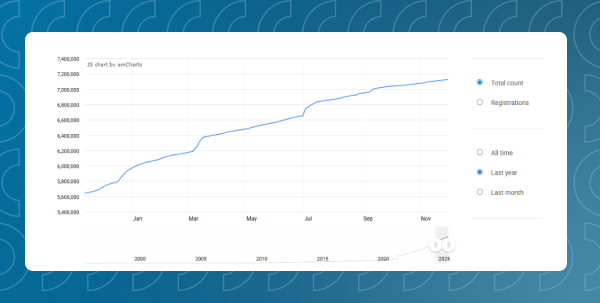
This TLD gives startups, digital agencies, and SaaS products a chance to secure short, brandable domains without paying premium aftermarket prices for a .com.
Finally, a small tip to keep in mind: when in doubt about advising your clients on their next domain extension, ask them this:
“Would you rather have a perfect-fit.co or a weird_compromised.com?”
Factors to consider when choosing between .co vs .com
Budget, total cost of ownership and margins
Registries price .com and .co differently, and promotions vary across time and providers:
- In many markets, .com is competitively priced but may command higher fees, especially for premium names. Like real estate, already-taken .coms can cost millions: for instance, in early 2025, AI.com was quoted at $100M
- .co can be slightly more expensive at renewal than entry-level .com domains, but still cheaper than acquiring a premium .com from the aftermarket.
For Openprovider resellers, margin is the key factor.
For domain reselling, digital agency and web hosting businesses like yours, domains are one item in a much bigger service mix.
With an Openprovider Membership, you buy .co and .com at direct registry cost, which means you can:
- Keep retail prices attractive while still protecting your markup,
- Run your own promotions without worrying about sudden registrar price hikes, and
- Use discounts to package domains with SSL, email and DNS into higher-value bundles.
See for yourself: calculate your future savings
Insert your TLD and check out the domain price for Members vs non-Members, including the potential saving you can generate.
Legal, security and reputational risk
Many clients don’t consider these issues until something goes wrong, making this a prime area where you can provide real value:
- Some lesser-known TLDs have higher rates of spam or abuse, which can affect email deliverability and brand perception. .co and .com both have broad adoption and generally good reputational baselines, as long as the operator upholds solid abuse policies.
- Clients handling personal data or operating under regulations (GDPR, NIS2, etc.) will need a registrar and DNS partner with strong security posture and compliance, not just a good TLD. Openprovider’s ISO/IEC 27001:2022 certification, which guarantees enhanced data protection and risk management practices in place, is one way you can reassure them their domains and DNS are being managed inside a mature security framework.
Portfolio strategy and future flexibility
Finally, zoom out from the single domain and look at the portfolio:
- Will the client launch more brands, campaigns or microsites in future?
- Do they need to protect their main brand name across multiple TLDs?
- How much operational overhead can their team handle?
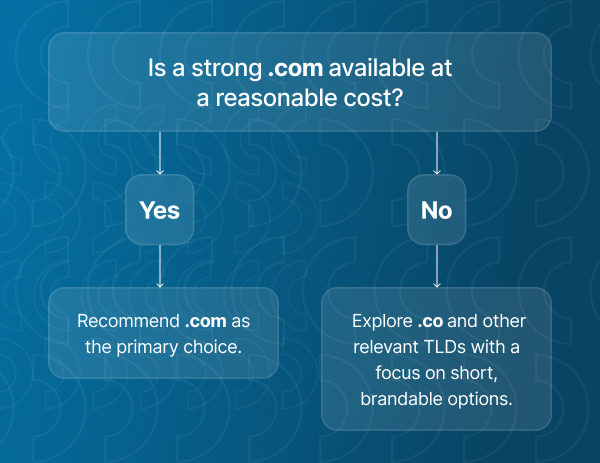
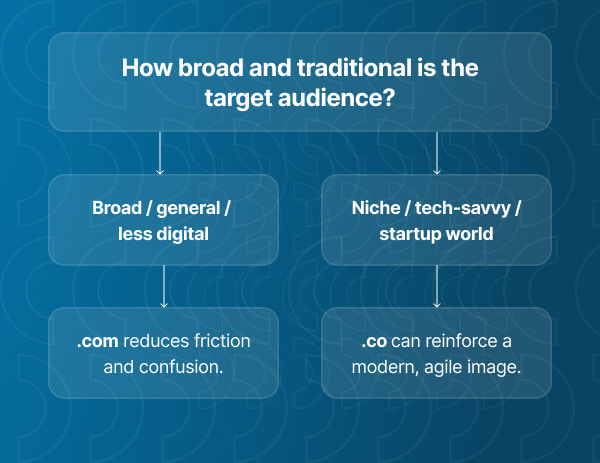
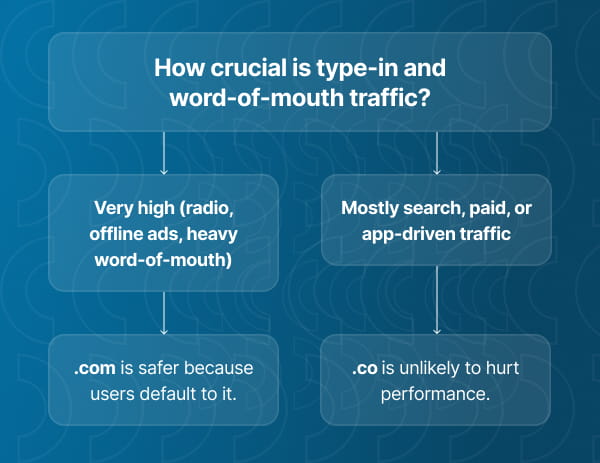
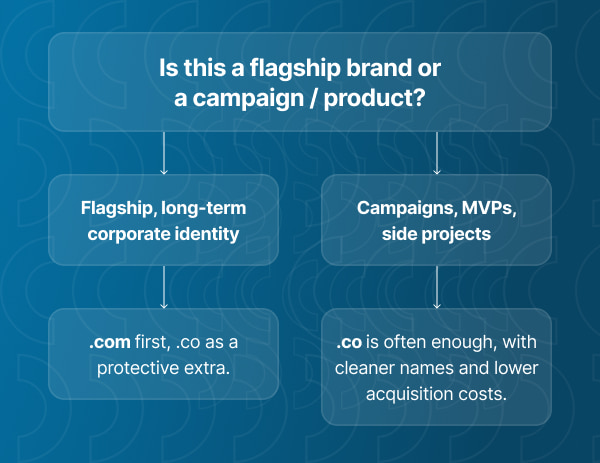
Quick diagram: .co vs .com decision checklist
Is a strong .com available at a reasonable cost?
How broad and traditional is the target audience?
How crucial is type-in and word-of-mouth traffic?
Is this a flagship brand or a campaign / product?
How To resell a .co or .com domain
Buy and sell .co or .com domains follow the same basic process.
1. Choose the name and extension
Start with a clear idea of the name and whether .co vs .com fits your brand and audience. Make a short list of options (brand name only, brand + keyword, or a simple phrase) and decide if you want just one extension, or both for brand protection.
2. Search availability with a trusted registrar or reseller
ICANN and EU guidance both recommend registering through established registrars and their resellers, who are certified to sell specific TLDs.
Run an instant search in the domain registration checkout, compare pricings, and check how they change based on the two extensions.
3. Review fees, term and any premium flags
Once you have a candidate:
- Check the registration and renewal fees. Different TLDs and premium names have different price points.
- Decide on the registration term (usually 1 to 10 years).
- Confirm whether the domain is a standard registration or a premium name with a higher initial price (standard domains are available at normal registration price, while premium domains are already owned or registry-priced higher due to desirability/market value)
Good to know
If you manage multiple domains for clients, an Openprovider Membership lets you buy .co, .com and other 1,900 + TLDs at direct registry cost, so you keep predictable margins even when prices change at registry level.
4. Enter registrant details and create your account
To register a domain, you must provide accurate contact details for the registrant, which become the basis of your registration agreement and the data held by the registrar and registry.
To do so:
For resellers, you can store these contacts and use them across multiple domains.
5. Configure DNS, nameservers and essential add-ons
After payment, the domain is registered but not yet live until DNS is configured. Normally, you should at least:
- Point the domain to the correct nameservers (your own, your host’s, or Openprovider’s),
- Add DNS records for the website (A, AAAA, CNAME) and email (MX, SPF, DKIM, DMARC),
- Secure it with an SSL certificate
6. Verify and keep control of your domain
Most registrars will send an email asking you to verify the registrant contact address, which is required under ICANN rules.
From there:
FAQs about .co vs .com domains
1. Is .co as good as .com for SEO?
Yes. Search engines treat .co as a generic top-level domain, similar to .com, so there is no inherent SEO penalty or boost for either extension. Your rankings will depend far more on content quality, site performance, technical setup and backlinks than on whether you choose .co or .com.
2. Which is better for my business: .co or .com?
It depends on your goals and audience.
- .com is still the most recognised and trusted extension worldwide. It is usually the best default for broad consumer brands, corporate websites, and businesses that want maximum familiarity and long-term stability.
- .co is popular with startups, digital-first brands and e-commerce projects that want a short, modern name when the ideal .com is taken or too expensive.
The safest approach is to check both options in the Openprovider domain registration search and weigh name quality, audience expectations and budget together.
3. Are .co domains cheaper than .com domains?
There is no universal rule that .co is cheaper or more expensive than .com. Registry fees, promotions and provider pricing all play a role.
The bigger financial difference usually appears when your ideal .com is already registered as a premium or aftermarket domain. In that case, a standard-priced .co will often be significantly more affordable. With an Openprovider Membership, resellers and agencies can buy both .co and .com at direct registry cost and then set their own retail margins.
4. Can anyone register a .co or .com domain with Openprovider?
Yes. Both .co and .com are open extensions, so there are no special eligibility requirements for most standard registrations.
As an Openprovider reseller, you can register these domains for yourself or for your clients directly through the Reseller Control Panel or via integrations and API, and manage DNS, SSL and other services from the same place.
5. Should I register both .co and .com for the same name?
If the name is important to your brand, it is often smart to register both .co and .com when possible. This helps you:
- Prevent competitors or domain investors from registering the alternate extension.
- Reduce the risk of lost traffic if users accidentally type the wrong TLD.
- Keep a consistent brand identity across channels.
A common setup is to use .com as the primary domain and redirect .co (and other strategic TLDs) to the main site, all managed centrally in Openprovider.
6. Can I transfer existing .co or .com domains to Openprovider?
In most cases, yes. To transfer a .co or .com domain to Openprovider, you typically need:
- The domain’s authorization (EPP) code.
- The domain to be unlocked at the current registrar.
- Enough time before expiry to complete the process.
Once the transfer is initiated and approved, you can manage all your .co, .com and other TLDs together via Openprovider, simplifying renewals and upsells like SSL certificates or business email.
Conclusion: choosing between .co vs .com in practice
In the end, .co vs .com is not a purely technical question. Both extensions work in the same way at DNS and search-engine level.
The real difference is in brand perception, availability and user behaviour.
Access this fast domain registration portal now and turn the .co vs .com choice into a more profitable part of your business.
Sources
1: Domain Name Stat
2: Domain Name Stat