
Choosing the right domain extension is one of the earliest and most strategic decisions a business makes when building its digital identity.
For many entrepreneurs, agencies, and fast-growing digital teams, the choice often narrows to .co vs .net, two popular alternatives when a preferred .com name is already taken or when the brand strategy calls for something more distinctive. The difference between .co and .net is more than stylistic- each extension carries its own meaning, audience expectations, and opportunities for branding and SEO.
In this guide, we break down what each extension stands for, how they perform in practice, and when to choose one over the other. You will also learn how platforms like Openprovider help agencies, resellers, and web professionals register and manage these TLDs efficiently – especially at scale.
What is a .net domain?
With 24+ million registered .net domains at the date of writing, the .net TLD was originally intended for network-driven businesses such as internet service providers, hosting companies, and technical infrastructure operators.
Over the years, its use has expanded well beyond those roots. Today, businesses recognize .net as a trusted alternative for companies whose ideal .com is taken, especially those working in technology, software, digital services, or platform-based products.
While .net doesn’t carry the nonprofit connotation of .org or the global ubiquity of .com, it remains a clean, credible, and versatile top-level domain. It fits naturally within the family of classic extensions that customers recognise and trust.
For domain resellers, digital agencies, and hosting providers, .net is also a dependable choice when building international or multi-market portfolios.Securing one is straightforward through Openprovider’s domain registration platform, where you can search and register extensions in just a few clicks.

What is a .co domain?
With more than 7 million registered domains, the .co TLD began as the country code for Colombia, but it has since evolved into a global, mainstream domain used by startups, entrepreneurs, and modern digital brands.
Its short, memorable structure makes it a natural fit for companies that want a crisp, contemporary online identity, especially when the equivalent .com is already taken.
Because “co” can suggest “company”, “commerce”, or “community”, the extension has become popular among innovative businesses and fast-growing ventures that want a broad, international presence without feeling tied to a specific industry. Businesses often choose it for brand launches, product sites, and projects that prioritize simplicity and name availability.

For resellers, agencies, and hosting providers, .co is a high-demand option to include in client portfolios, particularly when working with startups or creative brands.
You can quickly check availability and register these domains for your clients through Openprovider’s domain registration platform.
.co vs .net: key differences explained
| Criterion / Factor | .co | .net |
| Original Purpose / History | Originally the country-code TLD (ccTLD) for Colombia; since 2010 made globally available and widely promoted as a short “company/commercial” alternative to .com. | One of the original generic TLDs (since 1985), created to serve network infrastructure, ISPs, hosting providers and other internet-related services. |
| Current typical use / Perception | Popular with startups, entrepreneurs, modern brands, especially when the desired .com is already taken. Seen as concise, modern, and brand-friendly. | Common among technology, hosting, infrastructure or internet-service businesses; also used by organizations and general websites when .com or .co are taken. |
| Branding Strength and memorability | Short and easy to remember; works well for companies wanting a modern, clean web address. | More traditional/conventional; may signal technical or service-oriented focus, which can work for infrastructure, SaaS, or tech-oriented brands. |
| Availability / Chances to get desired name | Often easier to register desired names compared with more saturated TLDs; less demand means higher chance to secure a short or brandable name. | Higher chance that many desirable names are already taken, though still less saturated compared with .com. |
| Industry or business fit | Well suited for startups, creative brands, e-commerce, projects seeking broad appeal and brand-centric presence. | Better suited for companies in tech, hosting, software, infrastructure, online services, or any brand wanting a “network / tech” association. |
| Market position and recognition | Less historically “established” than older generic domains (like .com or .org), but increasingly accepted, especially among newer, agile businesses. | Part of the original TLD set; widely recognized and has long-standing legitimacy in internet services and technical domains. |
| Best use case / Recommended for | Businesses or brands seeking a modern, memorable, brand-friendly name and broad, general-purpose appeal, especially if preferred .com is unavailable. | Technology, hosting or infrastructure providers, software and platform-level services, or businesses whose core is online services or networking. |
Key Observations
- The origins of .co and .net differ: .co started as a country-specific domain (for Colombia) but repositioned globally for commercial/company use; .net was built from the start for network and internet infrastructure contexts.
- Branding and memorability often favor .co thanks to its brevity and modern appeal – good for startups, creative ventures, and businesses aiming for a clean, memorable web identity.
- Industry alignment – .net tends to resonate more naturally with tech, hosting, SaaS, and internet-service companies; .co may feel more neutral, broad and brand-centric, making it flexible across sectors.
- Name availability – because .co tends to be less saturated than many common TLDs, the chances of grabbing a desirable, short domain are generally higher.
- Recognition and history – .net carries the weight of being an original generic TLD with long-standing use, which may translate into implicit legitimacy for technical or infrastructure-oriented sites.
How domain resellers choose between .co and .net
Choosing between .co and .net (or any other top-level domain) is a core branding and strategic decision.
For some clients, .co delivers a sleek, modern, brand-friendly name when .com isn’t available; for others (especially those in tech, infrastructure or service-based industries) .net conveys reliability, technical grounding, and domain credibility.
As a domain reseller, your value lies in matching the right domain extension to a client’s identity, industry and long-term vision.
But the success of that choice depends heavily on how you manage your domain portfolio, maintain consistency, and build trust.
That is where partnering with a registrar like Openprovider becomes a decisive advantage, offering both flexibility and confidence to you and your clients.
How Openprovider helps you choose and manage your TLD
One of the greatest advantages when you partner with Openprovider is access to 1,900+ top-level domains, everything from the most common generic TLDs to country-specific domains and newer, niche extensions.
Transparent pricing and reseller-friendly margins
Openprovider’s pricing model is designed with resellers in mind.
Because you get domains at the same cost price that Openprovider gets from registries, you avoid inflated mark-ups and retain flexibility to set your own margins.
This transparency means you can offer competitive, fair prices to your clients while maintaining a profitable business model yourself.
For clients, this translates into:
- Clear pricing
- No hidden markups
- One trustable, unified point of contact (you as a service provider)
For your agency or company, it means:
- Healthy margins (even when offering premium or less common TLDs)
- Higher retention with more upsell chances (with bundles over Premium SSLs, Premium DNS, or Business emails)
- One trustable partner to manage all your digital assets in one place (Openprovider)
Centralized control and simplicity at scale
Managing multiple domains for multiple clients can quickly become a headache.
With Openprovider you can deliver all those options from a single, unified platform: the Reseller Control Panel.
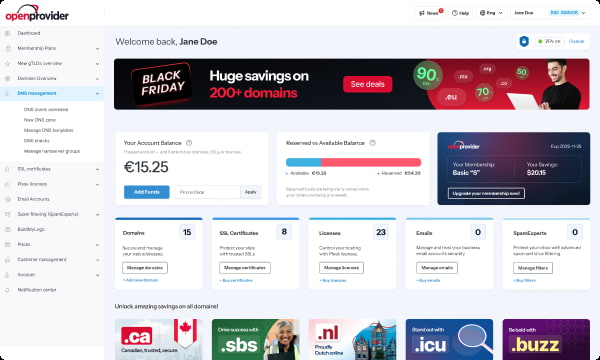
Here, you can register, renew, transfer domains, manage DNS, handle bulk operations and keep track of expiration dates, all from one place.
Opportunity to up-sell and build full-service offerings
Beyond domains, Openprovider’s ecosystem allows resellers to bundle complementary services under the same backend.
This opens up the opportunity to offer full-service packages: not just a domain name, but a ready-to-launch online identity with all necessary domain-related products.Ready to register your first .co or .net domain? Do it in seconds via our domain registration platform.