
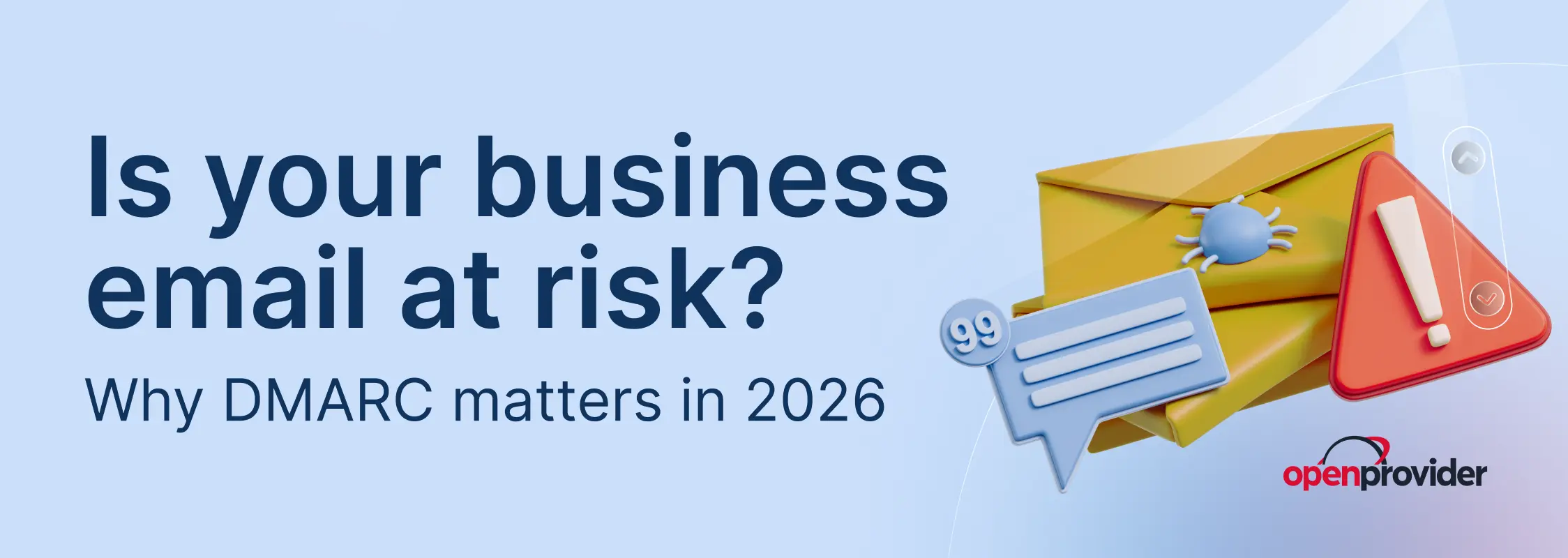
Email remains the backbone of business communication. Invoices, contracts, support requests, and internal conversations all depend on it. Yet the technology behind email was never designed with security as a priority.
At a technical level, email behaves more like a postcard than a sealed letter. The sender address can be forged, and receiving servers often accept it without proper verification. Attackers take advantage of this to impersonate executives, intercept payments, and damage brand credibility.
The hidden threat: email spoofing
The protocol behind email (SMTP) is built on trust. If a message claims to come from billing@yourcompany.com, most mail servers will accept it unless there is a specific reason not to.
This is what makes email spoofing so effective. Attackers do not need access to your systems. They simply send messages that pretend to come from your domain. These emails are the basis of phishing campaigns, spam, business email compromise (BEC) attacks, and other forms of email scams, all of which continue to increase each year.
How to protect your domain: SPF, DKIM, and DMARC
To reduce spoofing, three authentication standards are used together: SPF, DKIM, and DMARC.
SPF (Sender Policy Framework) tells receiving servers which IP addresses or email services are allowed to send email on behalf of your domain. It acts as a basic validation layer for legitimate senders.
The limitation is that SPF alone does not always block unauthorized messages. It can signal a problem, but delivery may still happen.
DKIM (DomainKeys Identified Mail) adds a digital signature to each email. This confirms that the message comes from your domain and that the content has not been altered in transit.
DKIM only applies to emails that are correctly signed. It cannot stop spoofed messages that are sent without a valid signature.
DMARC (Domain-based Message Authentication, Reporting & Conformance) connects SPF and DKIM and adds policy enforcement. It allows you to define what should happen when this double authentication fails, such as rejecting emails that claim to come from your domain but cannot be verified.
DMARC also provides reporting, giving insight into who is sending email using your domain, including unknown services, misconfigurations, or phishing attempts.
Why DMARC is now a standard requirement
DMARC is rapidly becoming a baseline expectation in the online world. Since late 2024, major mailbox providers such as Google and Yahoo have required DMARC for bulk senders. Without it, legitimate emails are more likely to be filtered as spam or blocked.
At the same time, phishing emails have become more convincing. Every day, over 3 billion spam messages are sent. Nowadays, AI-generated messages can match tone, branding, and writing style, making them difficult for employees and customers to recognize. DMARC stops these emails at the protocol level, before they reach an inbox.
There is also the business impact. A single spoofing incident can lead to financial loss, data exposure, and long-term reputational damage. Remember: the average data breach costs an organization over $4 million!
EasyDMARC: practical email security for resellers and clients
Implementing DMARC correctly can be complex. A strict policy applied incorrectly or too early can block legitimate emails and disrupt communication.
EasyDMARC simplifies this process. This tool provides guided setup for SPF, DKIM, and DMARC, clear visibility into all sending sources, and automated analysis of configuration issues. This makes it easier to move to a strict DMARC policy in a controlled way.
For resellers, EasyDMARC adds a security layer that fits naturally into a domain portfolio. It helps protect your customers’ brands while also strengthening their trust in your own services.
Start before an incident forces the issue
Most organizations only review email security after something goes wrong. By that point, the impact is already visible.
Don’t wait for an attack to happen. Help your clients secure their emails and ensure deliverability in 2026 and the years to come.