
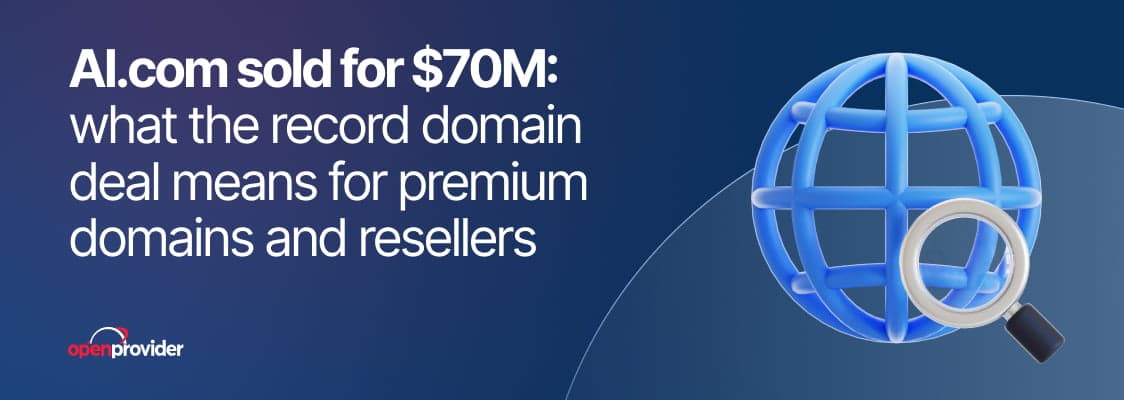
The AI.com domain sold for 70 million dollars: as reported below, the Financial Times mentioned this sale as tied to Crypto.com founder Kris Marszalek.
If you are a domain reseller, web hoster, or agency, the interesting part is not the number.
It is the mechanics behind it: why two-letter .com domains behave differently from “normal” premium names, how valuation works when comps are scarce, and what this story says about trust when hype meets a confusing or fragile launch experience.
In this guide, we’ll break down the AI.com sale in plain English, then translate the takeaways into reseller-friendly moves you can actually use to sell more premium domain names to your customers.
Along the way, we’ll connect the dots to the operational side: transparent pricing, predictable transfers, and a checkout experience that makes your customers feel safe.
What happened with the AI.com sale (and why it made headlines)
AI.com was reported as a $70 million purchase by Kris Marszalek (Crypto.com co-founder and CEO), and several reputable outlets characterized it as the largest publicly disclosed domain sale to date.
The reporting also highlights that the deal was paid entirely in cryptocurrency, and the timing mattered as much as the number.
Coverage notes Marszalek planned to debut the new AI.com experience around Super Bowl 2026 exposure, positioning it as a consumer-facing “personal AI agent” product.
Why ultra-premium .com domains are valued differently
A domain like AI.com is not priced like a typical premium listing, because of different reasons, spanning from the exact match with the word “AI” to the high demand of .com TLDs.
It is competing as digital real estate with scarcity built in: two-character .com domains are finite, globally legible, and instantly brandable across markets.
That combination is why record sales tend to cluster around short, category-defining names, and why buyers treat them less like “marketing expenses” and more like long-term strategic assets.
For resellers and agencies, the more practical takeaway is this: most customers will never buy a $70M domain, but they absolutely do buy the idea behind it.
If the domain reseller’s job is to make that purchase feel straightforward, safe, and useful, the domain provider’s job is to make this repeatable, scalable, and secure.
In terms of costs, the most accessible wayto do this is to exploit domains at wholesale price via the Membership plans.
Is $70M fair? How premium domain valuation actually works
If you look at domain valuation the way most operators do, you start with analyzing comparable sales. That works well for domains with lots of nearby examples, like three-word service names or “brandable” two-syllable domains.
But it gets messy fast when the asset is a two-letter .com and the keyword is a category-defining acronym at peak demand. In those cases, the “comp set” is tiny, and the buyer’s distribution plan (Super Bowl visibility, mass-market positioning, future brand moat) matters as much as historical pricing.
NameBio’s public leaderboard now lists AI.com as the #1 publicly recorded sale at $70,000,000, dated 2025-04-10, which is why so many headlines call it the biggest publicly disclosed domain deal.
That’s also why liquidity is the uncomfortable truth in domain investing. Most domains will never see a buyer at any price, while a tiny slice trades in bespoke, relationship-driven deals where the end user’s timing and intent outweigh everything else.
AI.com is a reminder that the peak of the market behaves like private equity, not like retail domain pricing.
Bonus tip
Checkout the difference of .ai vs .com domains.
Reseller-ready valuation checklist
When customers ask, “why is this domain so expensive?”, don’t reach for hype.
Walk them through this simple checklist to help them question their choice and find the perfect domain.
| AREA | BREAKDOWN |
| Fit and intent | Does the name map clearly to the client’s product, market, and positioning? |
| Scarcity and structure | Short .com domains are scarce; for instance, there are only 676 possible two-letter .com combinations (26×26) |
| Traffic signals | Type-in traffic, branded search demand, and any measurable direct navigation |
| Link profile and history | Backlinks, prior use, and any penalty from past content or spam |
| Trademark and dispute risk | Check for obvious conflicts and think through UDRP exposure |
| Transfer friction | Expected timelines, locks, required documents, and whether the seller can prove clean ownership |
| Renewal and premium fees | Confirm whether ongoing costs are standard or premium (especially outside .com) |
| Go-to-market plan | Will the buyer actually use the domain in a way that earns back the premium? |
Did you know?
If you sell an aftermarket domain to your customers via Openprovider, you can offer low pricing on the years of renewal after the initial purchase.
We recommend checking our Membership plans to access domains at wholesale price.
The “mysterious website” problem: when hype outpaces trust
Part of what made AI.com such an attention magnet is that it has historically redirected to different AI-related destinations, which trained people to click out of curiosity and then ask, “Who actually owns this?”
That dynamic is fun for spectators, but it’s risky for anyone trying to build a durable brand on the other side of the click.
In mainstream coverage, Marszalek frames the purchase of AI.com as a strategic move to control a critical digital touchpoint and avoid commoditization, especially as AI becomes a long-term platform shift.
That story makes sense, but it also raises the standard: if you buy the most obvious, most expensive front door on the internet, your experience has to feel reliable from the first second.
If you want to test fully controlled domain management without friction, start with a free sign-up.
Conclusion: turn domain demand into revenue
AI.com is a headline because $70M is a headline.
But for resellers, web hosting companies, and agencies, the deeper lesson is more actionable: premium domains are not “just names.”
They are trust accelerators, demand magnets, and brand shortcuts, but only when the operational layer behind them is clean, consistent, and built to scale.
That’s the part many teams underestimate.
The AI.com story mixed massive visibility with real-world friction, including reported downtime when traffic spiked after a Super Bowl push.
When you’re reselling premium domains, your systems must be ready to capture them, from DNS control to security to account access and ownership clarity.
In practice, a lot of revenue is lost not because the domain is wrong, but because the workflow around it is messy.
This is where Openprovider becomes a practical advantage for resellers, web hosters, and digital agencies that manage domains across many customers:
Openprovider’s Membership plans are designed to align cost structure with growth.
You can evaluate fit before committing, then move into a plan that supports higher volume and operational efficiency.
Start with a free sign-up on the Reseller Control Platform.